Alignment Specs by Model: Wrangler JK | Grand Cherokee ZJ | Renegade BU | Liberty KJ
Liberty KJ Alignment Spec Table
The factory caster specification for the 2002–2007 Jeep Liberty KJ is 3.9° preferred, with an acceptable range of 3.4° to 4.4°. Front camber is set to -0.375° preferred, while total toe should sit at 0.2°. These specifications apply to every KJ trim — Sport, Limited, and Renegade — across all model years.
Print this table or save it on your phone before your next alignment appointment. Having the exact factory numbers in front of the tech saves time and makes sure nothing gets set to a generic default.
Front Alignment Specifications
|
Measurement
|
Preferred
|
Acceptable Range
|
|
Total Toe
|
0.2°
|
+0.075° to +0.325°
|
|
Caster
|
3.9°
|
3.4° to 4.4°
|
|
Camber (Fixed Angle)
|
-0.375°
|
-0.750° to 0°
|
Rear Alignment Specifications
|
Measurement
|
Preferred
|
Acceptable Range
|
|
Total Toe
|
0.25°
|
-0.16° to 0.66°
|
|
Thrust Angle
|
0.00°
|
-0.25° to +0.25°
|
|
Camber (Fixed Angle)
|
-0.25°
|
-0.625° to 0.125°
|
Note: These specifications are consistent across all 2002–2007 Liberty KJ trims, including the Sport, Limited, and Renegade editions. If your KJ has a suspension lift, aftermarket control arms, or modified steering components, your ideal settings will differ from the factory numbers — more on that below.
What These Alignment Values Mean
If you have ever looked at an alignment printout and wondered what all those angles actually do, you are not alone. Here is what each measurement controls on your Liberty KJ and why the factory set them where it did. For a deeper breakdown of all three angles, check out our Caster, Camber, and Toe Explained guide.
Caster
Caster is the forward or rearward tilt of your steering axis when viewed from the side. On the Liberty KJ, the preferred caster angle is 3.9° positive, meaning the upper ball joint sits behind the lower one. This positive angle gives you straight-line stability at highway speeds and helps the steering wheel return to center after a turn. If your caster is too low, the KJ will feel wander-prone and vague on the highway. Too high and the steering can feel heavy, especially at low speeds and in parking lots.
Side-to-side caster difference matters too. If the left and right sides are more than 0.5° apart, your Liberty will pull toward the side with less caster. For more on how caster works across Jeep platforms, see our Jeep Caster Angle Settings Explained guide.
Camber
Camber is the inward or outward tilt of the tire when viewed from the front. The KJ's preferred front camber is -0.375°, which is a slight negative angle — the top of the tire leans inward just a touch. This mild negative camber improves cornering grip and compensates for suspension flex under load. On the rear axle, the preferred camber is -0.25°.
Both front and rear camber on the Liberty KJ are listed as "fixed angle" in the factory specs, meaning they are not independently adjustable the way caster is. If your camber readings are outside the acceptable range, that usually points to worn or bent suspension components rather than a simple adjustment issue.
Toe
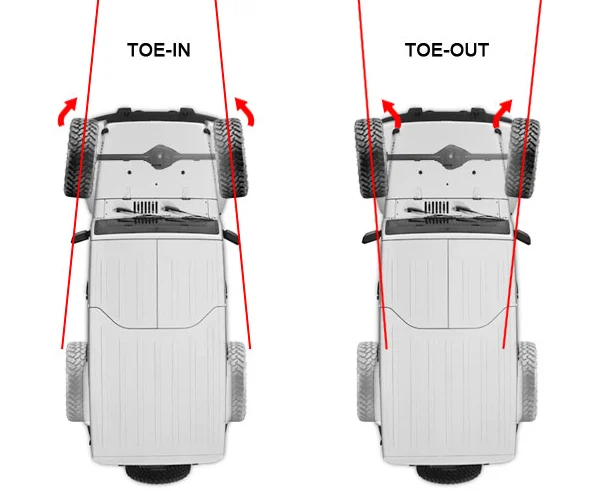
Toe describes whether your tires point slightly inward (toe-in) or outward (toe-out) when viewed from above. The KJ's preferred front total toe is 0.2° of toe-in, and the rear is set at 0.25° toe-in. That small inward angle improves directional stability and helps counteract the natural tendency of the suspension to push the wheels outward under driving forces.
Toe is the most sensitive alignment setting when it comes to tire wear. Even a small amount of excess toe — in or out — will scrub your tread and leave a feathered wear pattern across the tire surface. If you are chewing through tires faster than expected, toe is the first thing to check. Our Jeep Toe: What It Means guide covers this in detail.
Thrust Angle
Thrust angle measures how well the rear axle points in the same direction as the vehicle centerline. On the Liberty KJ, the preferred thrust angle is 0.00° with an acceptable range of -0.25° to +0.25°. A thrust angle outside that range means the rear axle is slightly skewed, which forces the front wheels to compensate and causes the steering wheel to sit off-center even when driving straight. Because the KJ's rear alignment angles are non-adjustable, a thrust angle problem usually indicates a bent axle, worn bushings, or frame damage.
Symptoms Your Jeep Liberty KJ Needs an Alignment
Common signs that your Jeep Liberty KJ needs a wheel alignment include uneven tire wear on the inner or outer edges, the vehicle pulling to one side on a flat road, a steering wheel that sits off-center when driving straight, and increased vibration at highway speeds. You should also get an alignment check after hitting a large pothole, curb strike, or trail obstacle.
Here are the most common indicators to watch for:
- Uneven tire wear: Look at the inner and outer edges of your front tires. If one edge is wearing faster than the other, your camber or toe is likely off. Feathered wear across the tread surface points to a toe issue specifically.
- Vehicle pulling to one side: If your KJ drifts left or right on a flat, straight road with no crown, you probably have a side-to-side caster or camber imbalance.
- Steering wheel off-center: When the wheel sits crooked while the vehicle tracks straight, your toe settings are uneven or your thrust angle is off.
- Vibration at highway speeds: While vibration can come from tire balance issues, alignment problems — especially toe — can contribute to a shimmy or shake that gets worse with speed.
- After any suspension modification: Installing a lift kit, new control arms, track bars, or even new ball joints changes your geometry. Always get a four-wheel alignment after suspension work.
- After a significant impact: A hard pothole hit, curb strike, or rock contact on the trail can knock your alignment out of spec instantly.
Do not wait until you see obvious tire wear to get checked. A quick alignment verification after any suspension change or impact can save you hundreds of dollars in premature tire replacement.
How Caster and Camber Are Adjusted on the Liberty KJ
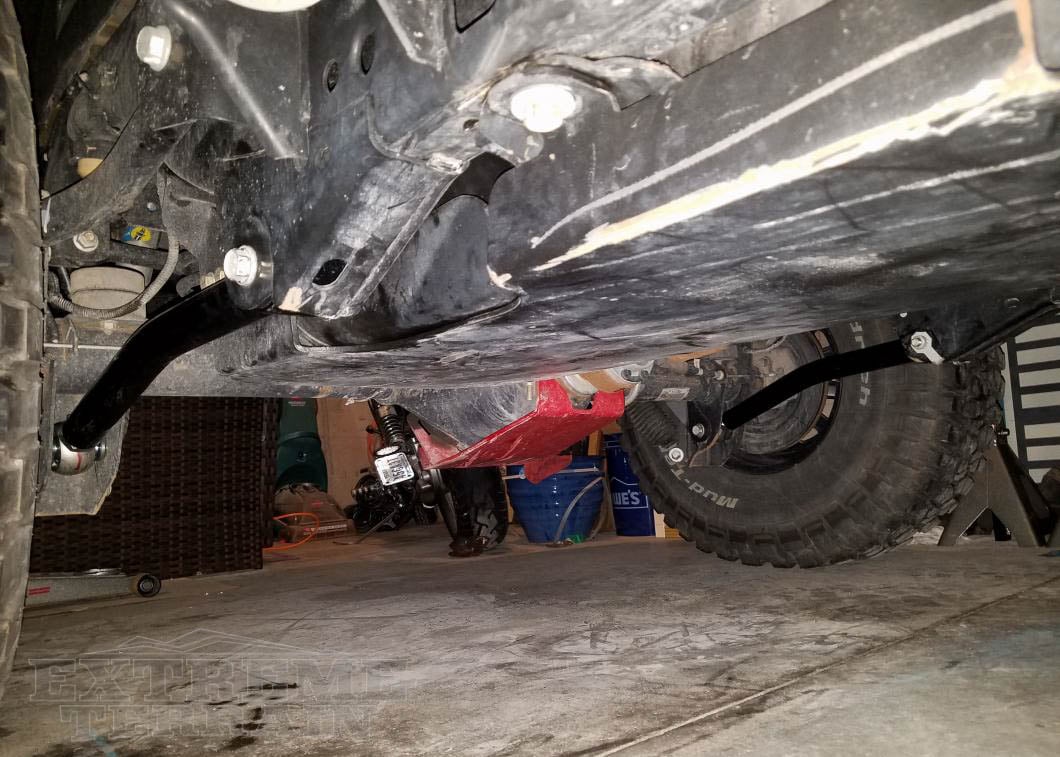
On the 2002–2007 Liberty KJ, front caster and camber are adjusted using cam bolts at the lower control arm mounting points on the axle side. The rear cam bolt controls caster adjustment, while moving both cam bolts together changes the camber angle. These cam bolts rotate within slotted holes to shift the axle position and change the alignment angles.
Here is what you need to know before heading to the alignment shop:
- Check for cam bolts first. Not every KJ still has its original cam bolts. If previous suspension work was done and standard bolts were used as replacements, the tech will not be able to adjust caster or camber without installing new cam bolt kits.
- Torque specification: Cam bolts should be torqued to 125 ft-lbs once the alignment is set.
- Rear alignment is non-adjustable. The rear camber, toe, and thrust angle on the Liberty KJ are all fixed. If rear readings are out of spec, the cause is typically worn bushings, a bent component, or frame/unibody damage — not a missing adjustment.
- Seized cam bolts: On higher-mileage KJs, especially those driven in rust-prone climates, the cam bolts can seize in place. Penetrating oil and patience are your best friends here. If they snap, you will need replacement hardware before the alignment can proceed.
If you are upgrading your control arms or steering components, our Control Arms Essential Guide covers what to look for in aftermarket options that affect alignment geometry.
Alignment Considerations for Lifted Liberty KJs
![]() If you have added a suspension lift to your Liberty KJ, the factory alignment specifications no longer apply as-is. Lifting the vehicle changes the geometry of the control arms, which shifts caster and camber angles. The taller the lift, the more pronounced the change.
If you have added a suspension lift to your Liberty KJ, the factory alignment specifications no longer apply as-is. Lifting the vehicle changes the geometry of the control arms, which shifts caster and camber angles. The taller the lift, the more pronounced the change.
Here is what to keep in mind:
- Adjusted caster targets: Most KJ owners running a 2- to 3-inch lift find that a caster setting between 2.5° and 3.0° provides the best balance of straight-line tracking and steering feel. Going much below 2.5° tends to introduce wander.
- Get aligned immediately after installation. Do not drive on a freshly lifted KJ without a four-wheel alignment. Even a short drive with severely off-spec angles can begin damaging tire tread.
- Measure ride height. Before the alignment, have the tech measure and record your current ride height at each corner. This gives a baseline so you can track suspension settling over time and know when you need a re-alignment.
- Adjustable control arms may be needed. If the cam bolts do not provide enough range to bring your caster back into a usable window after a larger lift, aftermarket adjustable control arms are the next step. They give you a wider correction range than the factory cam bolt slots allow.
- Re-check after settling. New lift kits — especially those with new springs — tend to settle in the first 500 to 1,000 miles. Plan on a re-alignment once the suspension has fully settled.
Are you planning a lift for your Liberty KJ, or trying to dial in alignment after one? For more on how wheel and tire sizing interacts with alignment and suspension geometry, check out our Jeep Wheel Specifications Guide. And if you want help picking the right parts for your specific build, reach out to one of our Sales Techs. They are real Jeep enthusiasts who can walk you through the best setup for how you use your rig — no scripts, no call centers, just real advice.
Frequently Asked Questions About Liberty KJ Wheel Alignment
These are the most common questions Jeep Liberty KJ owners ask about wheel alignment specifications, adjustments, and maintenance.
What Are the Factory Alignment Specs for a Jeep Liberty KJ?
The 2002–2007 Jeep Liberty KJ has a preferred front caster of 3.9°, front camber of -0.375°, and front total toe of 0.2°. Rear specs are 0.25° total toe, 0.00° thrust angle, and -0.25° camber. These specs apply to all KJ trims including Sport, Limited, and Renegade.
How Do You Adjust Camber and Caster on a Jeep Liberty KJ?
Caster and camber on the Liberty KJ are adjusted using cam bolts in the lower control arm mounting points. Moving the rear cam bolt changes caster significantly. Moving both cam bolts together changes camber. Cam bolts should be torqued to 125 ft-lbs after adjustment. The rear alignment angles are non-adjustable.
What Are the Symptoms of Bad Wheel Alignment on a Jeep Liberty?
Common symptoms include uneven tire wear on the inner or outer tread edges, the vehicle pulling to one side on flat roads, a steering wheel that sits off-center while driving straight, and increased vibration at highway speeds. You should also check alignment after hitting a large pothole or trail obstacle.
Is the Rear Alignment Adjustable on a Jeep Liberty KJ?
No. The rear camber, toe, and thrust angle on the 2002–2007 Liberty KJ are all fixed angles with no factory adjustment mechanism. If rear readings fall outside the acceptable range, the cause is typically worn bushings, a bent trailing arm, or unibody damage requiring component replacement.
What Alignment Specs Should I Use for a Lifted Jeep Liberty KJ?
Most Liberty KJ owners running a 2- to 3-inch suspension lift target a caster setting between 2.5° and 3.0° for the best balance of straight-line stability and steering feel. Going below 2.5° caster typically introduces highway wander. Always get a four-wheel alignment immediately after installing any lift kit.
What Is the Acceptable Range for Wheel Alignment on a Liberty KJ?
For the front, caster should fall between 3.4° and 4.4°, camber between -0.750° and 0°, and total toe between +0.075° and +0.325°. For the rear, total toe should be between -0.16° and 0.66°, thrust angle between -0.25° and +0.25°, and camber between -0.625° and 0.125°.