Whether your 2007–2018 Wrangler JK is riding on factory springs or sitting on a 4-inch lift with 35s, getting your wheel alignment specs right is one of the most important things you can do for tire life, steering feel, and on-road confidence. This guide covers the factory caster, camber, toe, and thrust angle values for every JK and JKU trim, explains what each angle actually does, and breaks down how lift kits change the numbers you need to target. If your rig is pulling, wearing tires unevenly, or throwing an ESP/BAS light after a lift install, you are in the right place.
Jeep Wrangler JK Alignment Spec Table
The stock wheel alignment specifications for the 2007–2018 Jeep Wrangler JK and JKU are identical across all trims and model years at factory ride height. Whether you have a two-door Sport or a four-door Sahara, the numbers below are what the alignment machine should read before you drive out of the shop.
For a deeper look at how each angle works together, check out our caster, camber, and toe guide.
Front Axle Alignment Specs
|
Angle
|
Preferred
|
Acceptable Range
|
Max Left/Right Difference
|
|
Caster
|
+4.2°
|
+3.7° to +4.7°
|
0.65°
|
|
Camber
|
−0.25°
|
−0.62° to +0.12°
|
0.50°
|
|
Total Toe-In
|
+0.20°
|
+0.17° to +0.23°
|
0.04°
|
Rear Axle Alignment Specs
|
Angle
|
Preferred
|
Acceptable Range
|
|
Total Toe
|
+0.25°
|
0° to +0.50°
|
|
Thrust Angle
|
0°
|
−0.25° to +0.25°
|
|
Camber
|
−0.25°
|
0° to −0.50°
|
Important Notes About JK Alignment Values
- Camber is nonadjustable. The JK uses a solid front axle with fixed knuckle geometry. If camber falls outside the acceptable range, the cause is typically a bent axle C, worn ball joints, or a damaged knuckle — not a setting you can dial in on the alignment rack.
- "Total toe" is the combined toe of both wheels. When the alignment printout lists individual per-wheel toe, the two values added together should equal the total toe figure above.
- Positive caster means the top of the steering knuckle tilts toward the rear of the vehicle.
- Negative camber means the top of the tire tilts slightly inward.
- Positive toe means the leading edges of the front tires point slightly toward each other (toe-in).
- These specs apply to all 2007–2018 JK and JKU trims at stock ride height. Once you add a lift, the target values — especially caster — change. See the lift kit section below for adjusted targets.
What Caster, Camber, and Toe Mean on Your Jeep JK
Caster, camber, and toe are the three alignment angles that determine how your Wrangler JK tracks down the road, how your tires wear, and how the steering wheel feels in your hands. Understanding what each one does makes it much easier to read an alignment printout and know whether your rig is dialed in or needs attention.
Caster
Caster is the forward or rearward tilt of the steering axis when viewed from the side of the vehicle. On the JK, the factory spec is +4.2° of positive caster, meaning the top of the steering knuckle tilts slightly toward the firewall.
Positive caster is what gives your Wrangler straight-line stability and self-centering steering — that feeling where the wheel wants to return to center after you round a corner. Too little caster and the JK feels loose and wandering at highway speed. Too much and the steering gets heavy.
For a stock-height JK, keeping caster within the +3.7° to +4.7° window keeps everything predictable. If you want to dig into caster targets for different setups, our caster angle settings guide breaks it down further.
Camber
Camber is the inward or outward tilt of the tire when viewed from the front of the vehicle. The JK factory spec calls for −0.25° of negative camber — the top of each front tire leans very slightly inward.
Here is the key thing to understand about camber on a Wrangler JK: it is a fixed angle. The solid front axle does not have any adjustment mechanism for camber. If your alignment printout shows camber outside the −0.62° to +0.12° range, something is physically bent or worn. The usual suspects are a bent axle C (the C-shaped casting the knuckle bolts to), worn upper or lower ball joints, or impact damage to the knuckle itself. You cannot fix out-of-range camber with adjustments — you need to replace the damaged component.
Toe
Toe is the difference in distance between the front edges and the rear edges of a pair of tires. On the JK, the factory spec is +0.20° of total toe-in, meaning the leading edges of the front tires point slightly toward each other.
Toe is the alignment angle you are most likely to adjust yourself. It is also the most common cause of uneven tire wear on a Wrangler — if your front tires are wearing fast on the inside or outside edges, incorrect toe is the first thing to check. You set toe by rotating the tie-rod adjuster sleeves with a crescent wrench. A tape measure between the front and rear edges of the tires (measured at hub height) gets you close enough for trail duty. For more detail, read our guide on what toe means for your Jeep.
Thrust Angle
Thrust angle is the direction the rear axle points relative to the centerline of the vehicle. The factory spec is 0° with a tolerance of ±0.25°.
On the JK, thrust angle is not adjustable. The rear axle is located by fixed-length control arms, so the angle is set by the factory geometry. If thrust angle drifts outside the acceptable range, it usually means a control arm bushing is worn, a control arm bracket is bent, or the axle has shifted on its mounts. A nonzero thrust angle causes the vehicle to "dog-track" — the rear end follows a slightly different path than the front, which accelerates rear tire wear and makes the steering wheel sit off-center even with perfect front alignment.
Signs Your Jeep JK Needs an Alignment
A bad alignment rarely announces itself all at once. It usually starts as something you notice and brush off — a slight pull, a little extra vibration — and then your tire tread tells you the full story 5,000 miles later. Here is what to watch for.
- Steering wheel off-center. If the steering wheel sits crooked when you are driving straight on a flat road, your toe or caster is off, or your front axle has shifted to one side (common after a lift install).
- Vehicle pulling left or right. Consistent pull usually points to unequal caster or camber side-to-side (cross-caster or cross-camber exceeding 0.5°). Check tire pressures first — uneven pressure mimics an alignment pull.
- Uneven or rapid tire wear. Inner-edge or outer-edge wear on the front tires is the classic toe or camber symptom. If you are chewing through a set of JK tires faster than expected, alignment should be your first check.
- Steering shimmy or vibration at highway speed. While shimmy has many causes — worn track bar bushings, out-of-balance tires, loose steering components — misalignment can contribute. Severe cases may point to the start of death wobble, which demands immediate inspection.
- ESP/BAS warning light after a lift installation. The electronic stability program uses the steering angle sensor. If you install a lift and do not recenter the steering wheel, the sensor reads an offset and triggers the ESP/BAS light. A proper alignment with steering wheel recentering clears it.
- "Flighty" or wandering feel on the highway. This is the classic symptom of low caster after a lift. The Wrangler feels like it wants to wander in its lane and does not track straight without constant small corrections. Restoring caster to the 4.5°–5.0° range fixes it.
If any of those symptoms match what your rig is doing, an alignment check is the logical next step. Even if everything feels fine, an alignment inspection after any suspension modification — lift kit, control arms, track bar, ball joints, tie-rod ends — is cheap insurance against premature tire wear.
How Lift Kits Affect JK Alignment
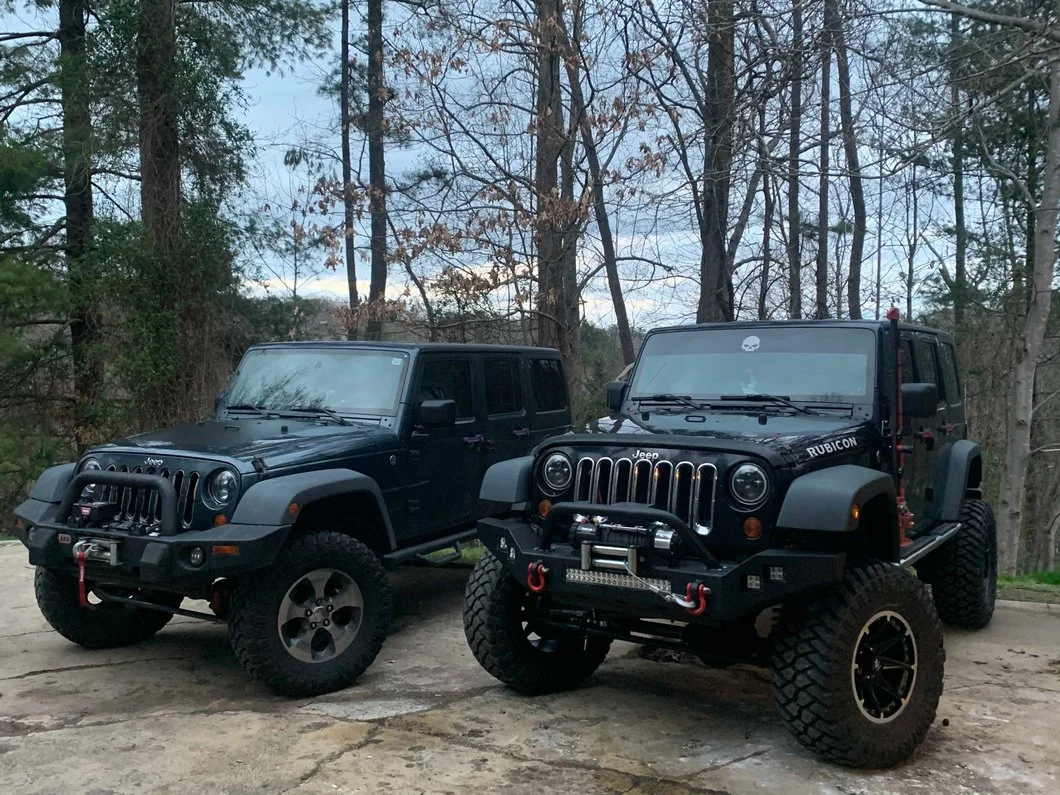
Installing a lift kit changes your Wrangler JK's suspension geometry, and that changes what alignment values you need to target. The taller the lift, the more correction you need. Here is how it breaks down by height.
Lifts Under 2.5 Inches
A mild lift — budget boost, leveling kit, or 2-inch spring set — creates minimal geometry change on the JK. The design of the JK front suspension means that small lifts do not significantly alter the tie-rod-to-drag-link relationship the way they do on older Jeeps like the TJ.
What you will typically need:
- A steering wheel recenter (rotate the drag link adjuster until the wheel sits straight)
- A toe adjustment to bring total toe back to +0.20°
- An alignment check to confirm caster and camber are still within range
Most JK lift kits in this height range do not require adjustable control arms, though it never hurts to confirm caster on the alignment rack. If caster drops below +3.7°, you may feel that highway wander even with a small lift.
Lifts of 3 Inches or More
This is where alignment correction becomes a requirement, not a suggestion. A 3-inch or taller lift does three things to your JK's front end:
- Caster drops. The longer suspension geometry tilts the axle forward, reducing positive caster. This is the primary cause of that "flighty" highway feel after a lift.
- The axle shifts toward the driver side. The track bar arc pushes the axle laterally as ride height increases, pulling the steering off-center.
- Steering angle changes. The drag link and tie-rod operate at steeper angles, which can affect bump steer and toe behavior over suspension travel.
To correct these issues, you need:
- Adjustable control arms (upper, lower, or both) to restore caster — target 4.5° to 5.0° for a stable highway feel. Our adjustable control arms guide covers the options.
- An adjustable front track bar to recenter the axle under the frame
- A full alignment with steering wheel recentering to clear any ESP/BAS codes
If you are planning a 3-inch lift, budget for these correction parts from the start. Skipping them means accelerated tire wear, a wandering steering feel, and a warning light on the dash. Not sure which control arms or track bar work for your specific lift height and tire size? An ExtremeTerrain Sales Tech — real Jeep enthusiasts who build and drive these rigs — can help you spec the right setup. For step-by-step guidance, see our lift kit installation guide.
Lifts of 4 Inches or More
A 4-inch-plus lift pushes the JK's front-end geometry well beyond what stock components can handle. At this height, you are typically looking at:
- A track bar relocation bracket to move the frame-side track bar mount upward and restore the bar to a more level angle
- A drag link flip kit or high-steer kit to correct the steering geometry at the knuckle
- Adjustable upper and lower control arms for full caster and pinion angle correction
- Possibly a steering stabilizer upgrade to manage the additional stress on the steering linkage
At this lift height, your target caster is still 4.5° to 5.0°, but getting there requires more hardware. Work with a shop that has experience aligning lifted Jeeps — the geometry corrections at 4+ inches are significant, and getting them right the first time saves you from chasing steering issues later.
Tools You Need for a Jeep JK Alignment
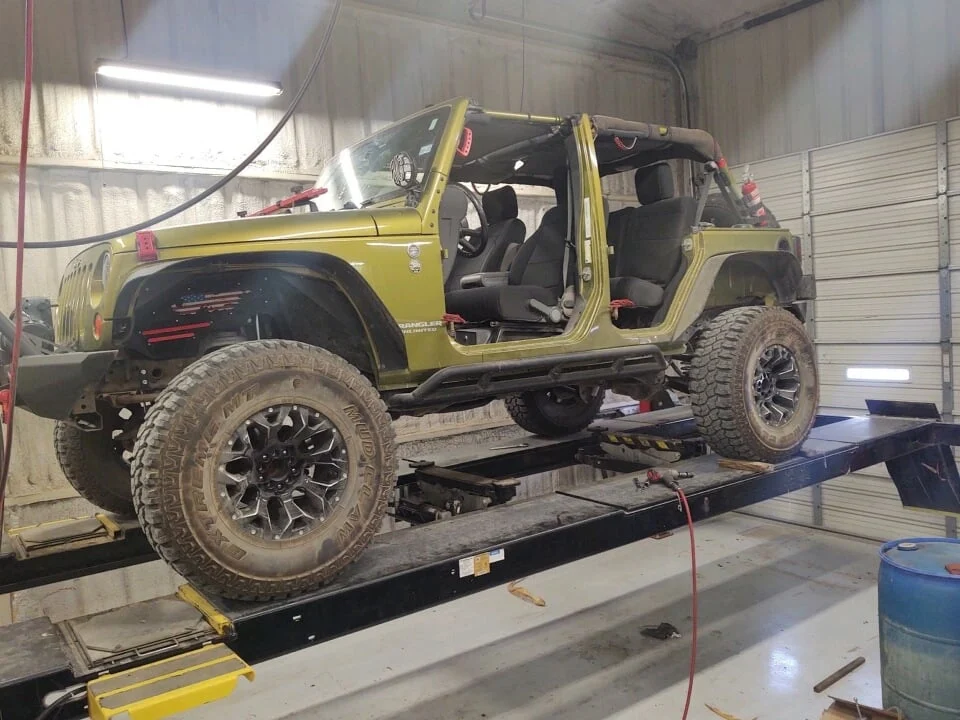
You can check and adjust toe-in at home with basic hand tools, and you can measure caster with an angle finder. Here is what to have on hand before you crawl under your rig.
- 15mm, 18mm, and 21mm sockets and wrenches — covers the tie-rod jam nuts, drag link adjuster, and track bar hardware
- Large crescent wrench — for rotating the tie-rod adjuster sleeves when setting toe
- Angle finder (digital or magnetic) — needed if you are measuring or setting caster with adjustable control arms
- Tape measure or toe-alignment gauge — measure the distance between the front and rear edges of the front tires at hub height to check toe-in Carpenter's level — useful for verifying that your rig is sitting level before taking measurements
- Floor jack and jack stands — you will need to get under the front end to access adjusters
- Penetrating oil — tie-rod adjusters and jam nuts seize up fast from trail mud, road salt, and moisture; soak them well before you wrench on anything
Browse our full selection of alignment tools and specialty wrenches to make the job easier. A basic toe adjustment with a tape measure takes about 20 minutes once you know the process. Caster adjustment with control arms takes longer and is more involved — if you are not comfortable with it, a shop alignment on a lifted JK typically runs between $80 and $150 and is money well spent.
Frequently Asked Questions About Jeep JK Wheel Alignment
Below you will find answers to the most common questions about Wrangler JK alignment specs, lift kit adjustments, and DIY alignment procedures.
Ready to get your JK's alignment sorted out? Browse ExtremeTerrain's full selection of JK suspension and lift kit components, adjustable control arms, and alignment tools for your 2007–2018 Wrangler JK. If you need help matching parts to your specific build — lift height, tire size, driving style — an ExtremeTerrain Sales Tech can point you to exactly what you need. They are real Jeep enthusiasts who wrench on the same rigs you do. For more technical deep-dives, explore our caster, camber, and toe guide and the rest of our Jeep tech guide library.
Frequently Asked Questions About Jeep JK Wheel Alignment
Proper wheel alignment keeps your Wrangler JK (2007–2018) tracking straight, extends tire life, and prevents steering issues — especially after installing a lift kit or new suspension components.
What Are the Stock Alignment Specs for a Jeep Wrangler JK?
The factory front-axle specs are caster +4.2° (±0.5°), camber −0.25° (±0.37°, fixed), and total toe-in +0.20° (±0.03°). Rear specs are total toe +0.25° (0°–0.5°), thrust angle 0° (±0.25°), and camber −0.25° (0° to −0.50°). These values apply to all 2007–2018 JK and JKU trims at stock ride height.
Do You Need an Alignment After Lifting a Jeep JK?
Yes. Any lift changes your suspension geometry and shifts the axle toward the driver side. Lifts under 2.5 inches may only need a steering-wheel recenter and toe adjustment, while lifts of 3 inches or more typically require adjustable control arms to correct caster and adjustable track bars to recenter the axle.
What Caster Angle Should a Lifted JK Wrangler Have?
Most experienced JK owners target 4.5° to 5.0° of positive caster on a lifted Wrangler to maintain highway stability. The stock setting is +4.2°, but lifts reduce caster, causing a "flighty" or wandering feel. Adjustable upper or lower control arms are the recommended way to restore proper caster.
What Causes a Jeep JK to Pull to One Side?
Common causes include unequal caster or camber side-to-side (cross-caster or cross-camber exceeding 0.5°), incorrect toe settings, an off-center front axle from a shifted track bar, or uneven tire pressure. Worn ball joints, bent tie-rod ends, and damaged steering components can also cause pulling.
Can You Do Your Own Alignment on a Jeep JK?
You can adjust toe-in at home using a tape measure or a toe-alignment tool from any parts store. Caster requires adjustable control arms and an angle finder. Camber is a fixed angle on the JK and cannot be adjusted — out-of-range camber indicates a bent axle C or worn ball joints that need replacement.
What Is the Difference Between Caster, Camber, and Toe?
Caster is the forward or rearward tilt of the steering knuckle and controls straight-line stability. Camber is the inward or outward tilt of the wheel and affects edge tire wear. Toe is the difference between the front and rear edges of the tires and is the final alignment adjustment — incorrect toe is the most common cause of uneven tire wear.
What Are the Symptoms of a Bad Alignment on a Jeep JK?
Signs include the steering wheel being off-center, the vehicle pulling left or right, uneven or rapid tire wear (especially on the edges), a shimmy or vibration at highway speeds, and the ESP/BAS warning light activating. After installing a lift, a misaligned steering wheel can trigger the electronic stability system.
What Tools Do You Need for a Jeep JK Alignment?
Basic tools include 15mm, 18mm, and 21mm sockets and wrenches, a large crescent wrench, a tape measure or toe-alignment gauge, a carpenter's level, an angle finder for caster measurement, a floor jack, and jack stands. Penetrating oil is helpful if tie-rod adjusters are seized from mud or salt exposure.