Owning a vehicle today is as much about smart financial decisions as it is about performance and capability. With rising prices, higher interest rates, and growing tariff concerns, more drivers are rethinking whether replacing their ride makes sense.
We surveyed 1,008 U.S. vehicle owners and paired those insights with financing and pricing data to understand how drivers are investing in their vehicles. What emerged is a clear shift toward upgrading instead of replacing, especially among enthusiasts who want more control over their builds.
Key Takeaways
- 1 in 2 vehicle owners (50%) actively upgraded their vehicle instead of replacing it, or seriously considered doing so, in the past year.
- Over half of vehicle owners (54%) delayed a planned vehicle purchase due to rising prices, interest rates, or tariff concerns. Of that group, only 13% plan to buy a replacement in the next 12 months.
- Ford owners are the most committed upgraders: 33% actively upgraded, 19% plan more upgrades, and 60% delayed a purchase.
- Over 4 in 5 vehicle owners (82%) say they would rather invest in their current vehicle than take on new debt.
- 1 in 3 truck owners (34%) actively upgraded instead of replacing in the past year.
- 63% of vehicle owners say tariffs or inflation have already changed how they think about buying a new vehicle, including 44% of people who have not even delayed a purchase yet.
The Stay & Upgrade Report
More drivers are choosing to hold onto their vehicles and put money into upgrades that improve performance, reliability, and longevity.
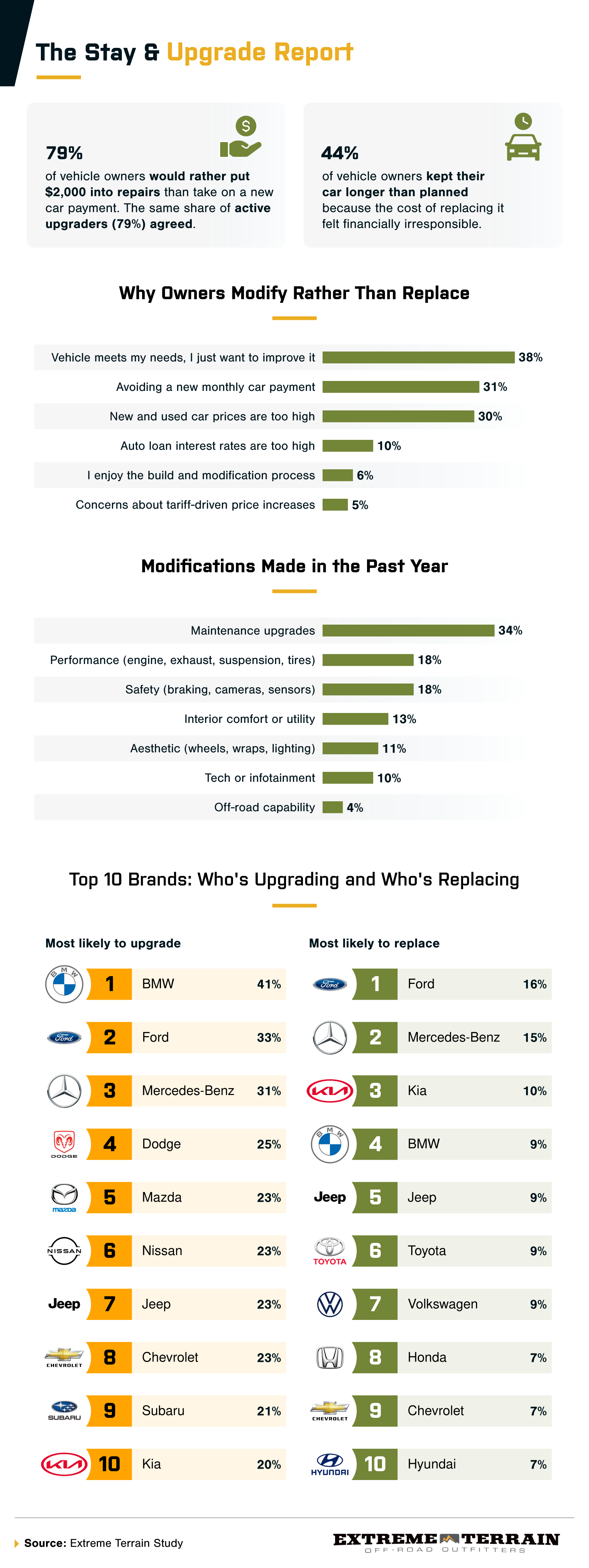
- 82% of vehicle owners say they would rather invest in their current vehicle than take on new debt.
- Among vehicle owners who delayed a planned purchase due to cost pressures (54%), only 13% plan to buy a replacement in the next 12 months.
- Over one-third of vehicle owners (36%) have made real financial trade-offs to keep their current vehicle: 19% have learned to do mechanical or modification work themselves to save on labor, and 16% have deferred other major purchases.
By Brand
- Ford owners are the most active upgraders of any major brand surveyed: 33% upgraded their vehicle instead of replacing it in the past year, 19% plan to invest in more upgrades over the next 12 months, and 60% have delayed a planned vehicle purchase due to rising costs.
- Nissan owners show the strongest resistance to replacement of any brand surveyed: just 3% plan to buy a new vehicle in the next 12 months, and 81% say they would rather put $2,000 into their current vehicle than take on a new car payment.
By Generation
- Gen Z (57%) and millennials (58%) are far more likely than baby boomers (37%) to have delayed a purchase due to cost pressures.
- Gen Z is also the most financially strained: 21% have deferred other major purchases entirely to fund their vehicle.
By Vehicle Age
- 62% of owners of vehicles 13 or more years old say they kept their vehicle longer than planned because replacing felt financially irresponsible.
- Over half of vehicle owners (52%) say they will not replace until a major system fails entirely, rising to 58% among 8-to-12-year vehicle owners and 56% among owners of 13-plus-year vehicles.
- Modification commitment deepens with vehicle age: owners of 13-plus-year vehicles have the highest modification rate (66%), and owners of 8-to-12-year vehicles have the highest average spend among active modifiers ($1,262).
The Real Cost of Replacing
The financial gap between upgrading and replacing has grown, making modifications a practical and often smarter path forward.
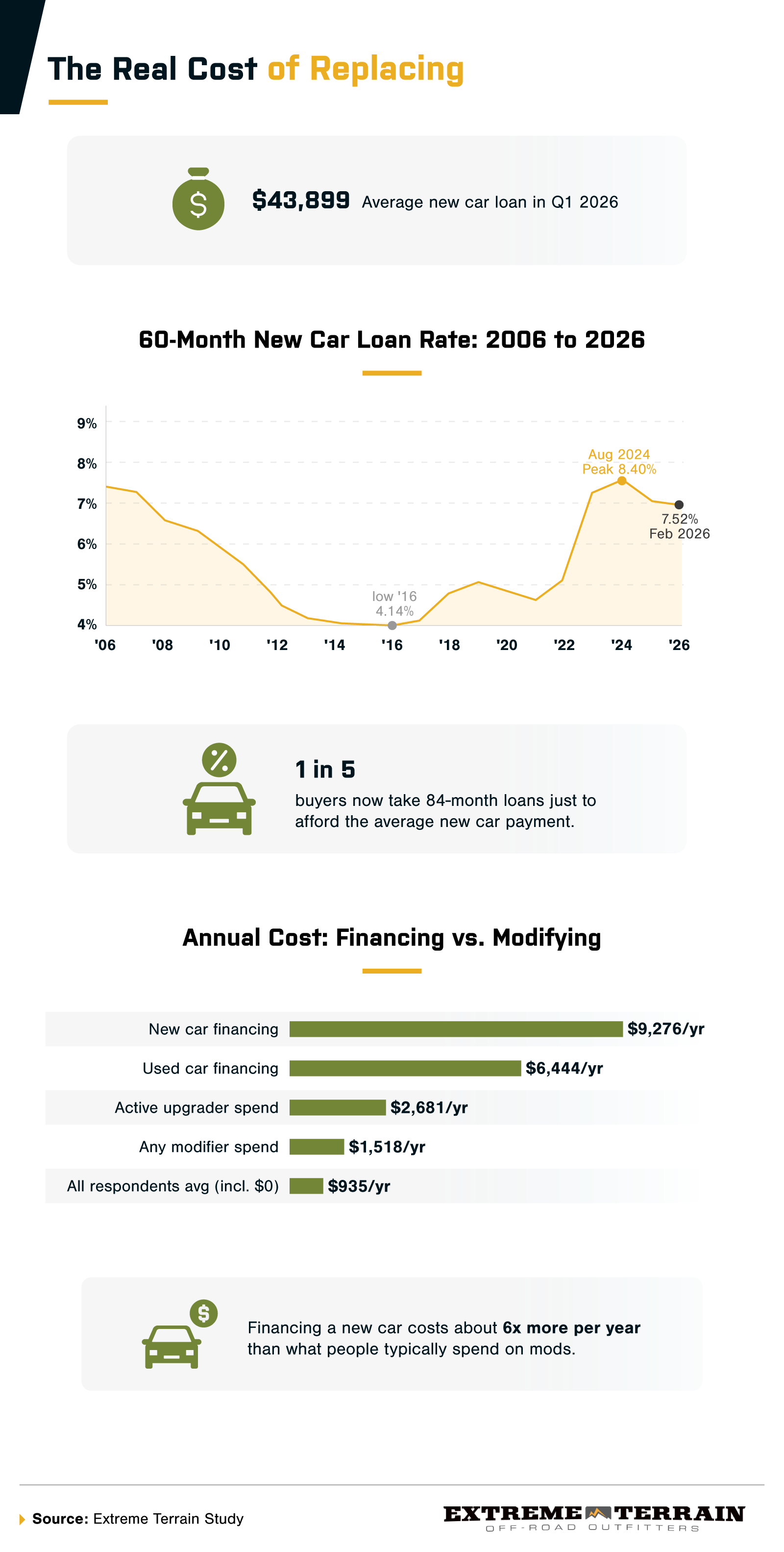
- Active upgraders save an estimated $6,595 per year versus financing a new vehicle, based on Edmunds Q1 2026 data showing average new car financing costs $9,276 annually ($773 per month on a record-high average loan of $43,899 at 6.9% APR).
- New car loan rates nearly doubled between early 2022 (4.52%) and August 2024 (8.40%), before easing to 6.9% by Q1 2026.
- Even at the lower rate, 84-month loans now account for a record 22.9% of all new car purchases.
- Tariff estimates range from $3,500 to $12,000 or more per vehicle, depending on country of origin, adding approximately $6,400 to the average vehicle price.
- At current Q1 2026 financing rates, that translates to roughly $126 per month in added cost on top of already-record loan amounts.
- For truck owners who modify rather than replace, roughly 70% of modification spend is estimated to be retained at resale, reducing the effective annual cost of a $1,480 mod budget to $444 and saving approximately $6,000 per year versus financing a used truck.
- 63% of vehicle owners say tariffs or inflation have already changed how they think about buying a new vehicle, including 44% of those who have not yet delayed a purchase at all.
Why Upgrading Is Taking Over
Rising ownership costs are pushing drivers to rethink long-term value. Instead of committing to higher monthly payments, many are choosing to upgrade key components and extend the life of their current vehicle. That approach gives you more control over both performance and budget.
For off-road enthusiasts, this shift makes even more sense. Every upgrade you make adds capability that is tailored to your driving style, whether you are building for trails, overlanding, or daily reliability. Instead of starting over, you are building something better over time.
Methodology
Survey: We surveyed 1,008 U.S. adult vehicle owners online via CloudResearch Connect. Respondents confirmed ownership of a primary personal vehicle. Percentages rounded to the nearest whole number. Multi-select percentages sum to more than 100%. Numeric averages IQR-filtered (1.5x). Ages converted to generations: Gen Z (18–29), millennials (30–45), Gen X (46–61), baby boomers (62+). Modification spend figures in ROI calculations use a quality-filtered subset of 879 respondents; see note below.
Active upgraders: Those who chose to upgrade their current vehicle instead of replacing it in the past year, either actively or with replacement still on the table (23% of respondents, n=229).
Sample: Millennials (49%), Gen X (26%), baby boomers (10%), Gen Z (14%) | women (57%), men (42%) | SUV/crossover (46%), sedan (40%), truck (7%), minivan (4%) | Vehicle age: 3–7yr (31%), 8–12yr (31%), 13+yr (25%), under 3yr (13%) | South (47%), West (25%), Northeast (21%), Midwest (21%) | suburban (62%), rural (27%), urban (26%)
Brand sample note: BMW, Mercedes-Benz, Mazda, Dodge, Jeep, Subaru, Kia, Volkswagen, and Lexus each represent fewer than 50 respondents (margin of error ±14% or greater). Treat as directional only.
External Sources
- New car financing: Edmunds State of the Automotive Finance Market, Q1 2026
- Used car financing: Experian State of the Automotive Finance Market, Q4 2025
- Loan rate trend: Federal Reserve G.19 (RIFLPBCIANM60NM) via FRED, Aug 2006–Feb 2026
- Used vehicle price trends: Manheim MUVVI quarterly presentations, Q4 2022–Q4 2025 (Cox Automotive). Annual segment changes applied to 2020 retail baselines as directional estimates. MUVVI tracks wholesale, not retail prices.
- Tariff estimates: Anderson Economic Group, Cox Automotive, Yale Budget Lab, TrueCar Auto Tariff Tracker (2025–2026)
- Modification value retention: iSeeCars, Black Book (verify before publication)
- Aftermarket baseline: SEMA Market Report, 2024
About Extreme Terrain
Extreme Terrain supports Jeep enthusiasts with performance upgrades that match their driving style. From dusty trails to daily commutes, Extreme Terrain offers cold air intakes designed to improve airflow, throttle response, and overall engine efficiency.
Fair Use Statement
Information from this article may be shared for noncommercial purposes only. If you do use or reference this content, please include a link back to ExtremeTerrain for proper attribution.