The Skill Slipping Away From Younger Drivers
Driving a manual is still common among American drivers, but the skill thins out with every younger generation.
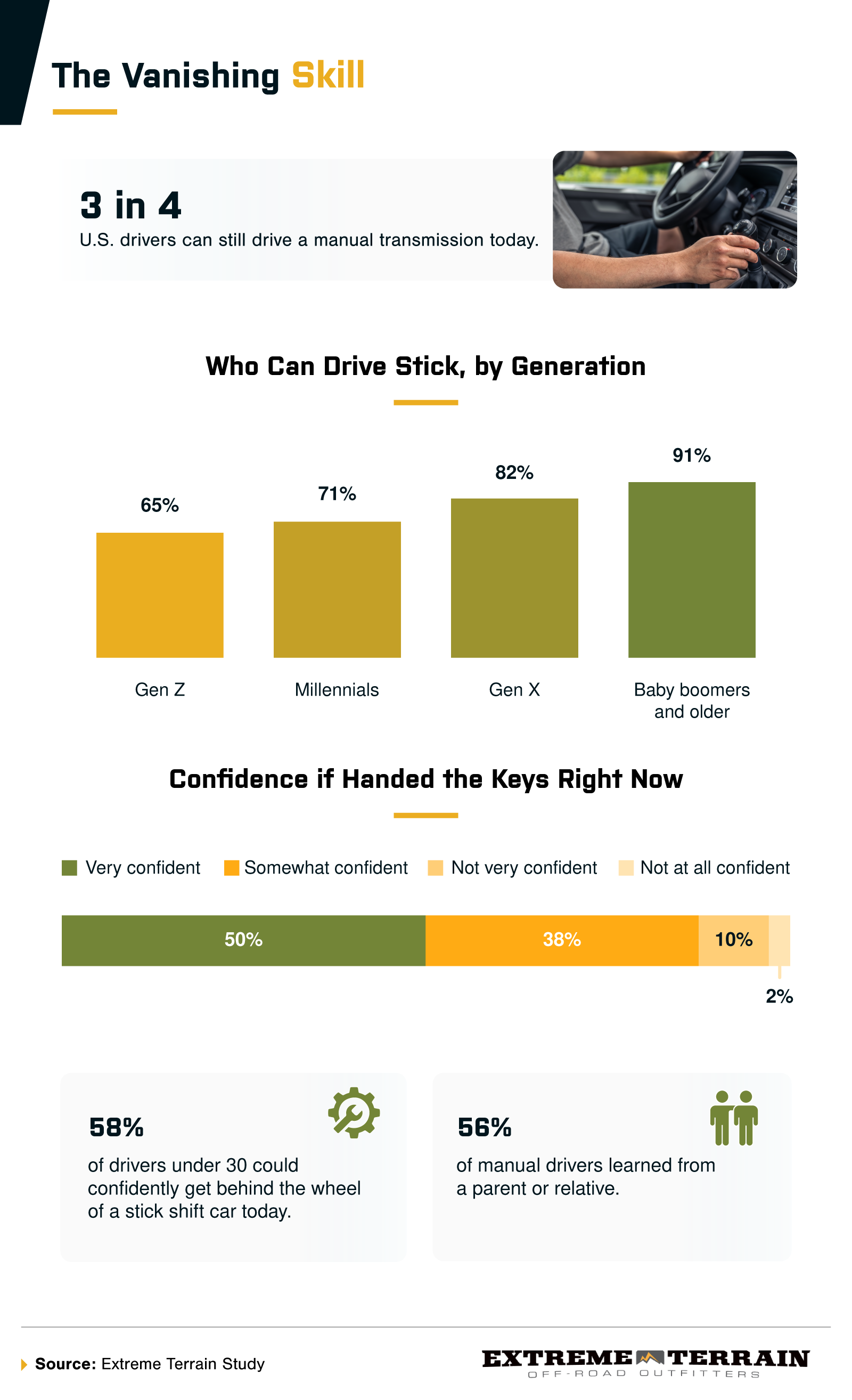
Three-quarters of U.S. drivers said they can drive a manual, yet that ability falls off sharply by age:
- Baby boomers (91%)
- Gen X (82%)
- Millennials (71%)
- Gen Z (65%)
That gap means over a third of Gen Z drivers (35%) never learned to drive stick at all, compared with just 9% of baby boomers. Confidence is even scarcer among the young, as only 58% of drivers under 30 said they could get behind the wheel of a stick shift today and drive it well.
Men were more likely than women to know how (82% versus 69%), and most people learned the old-fashioned way. More than half of manual drivers (56%) picked it up from a parent or relative, while 27% learned from a friend or partner. The reason they learned has flipped over time, too. Among Gen Z, 55% learned by choice and only 22% out of necessity, while 55% of baby boomers learned because they had to and just 23% did it by choice.
Knowing how doesn't mean using it. Among those who can drive stick, 64% said they rarely or never do, and 31% never drive one despite having the skill. Ownership told the same story, as former manual owners (49%) outnumbered current owners (13%) by nearly four times.
Why Driving Stick Still Signals Skill and Status
Even as the skill fades, Americans still treat driving a manual as a mark of talent and character.
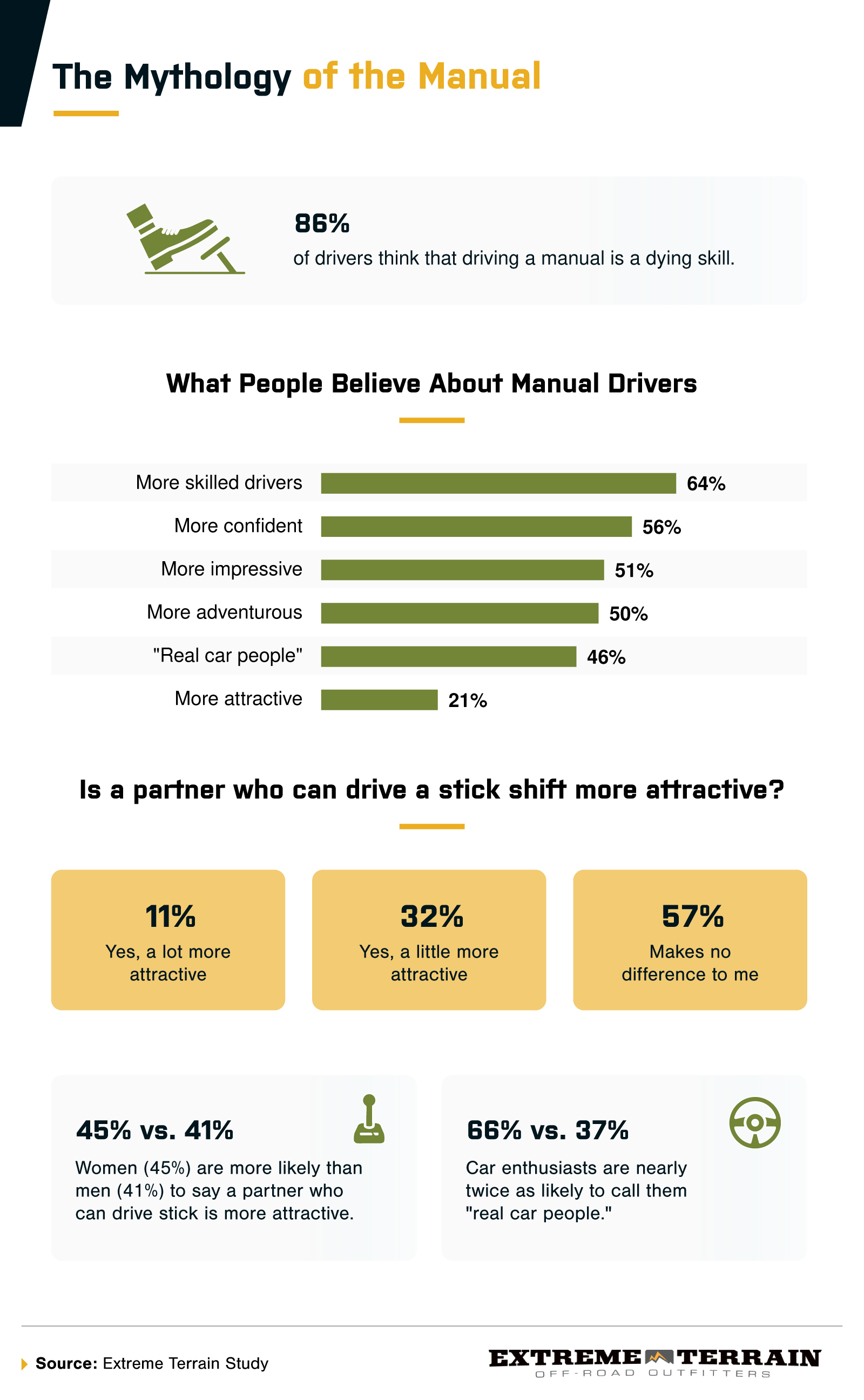
Manual drivers earn real credit for their ability. A solid majority of Americans (64%) said manual drivers are more skilled than those who only drive automatics, and 51% called them more impressive, even though 86% believed the skill is dying. The "real car person" label sticks, too, with 46% associating driving stick with being a genuine car enthusiast, a figure that climbed to 66% among self-described enthusiasts and dropped to 37% among everyone else.
Driving stick even carries a little romance. Over two-fifths of Americans (43%) said a partner who can drive a manual is more attractive, and women felt this slightly more strongly than men (45% versus 41%), including being a bit more likely to call it "a lot" more attractive. Put it on a dating profile and 40% would be impressed, though 17% would read it as bragging.
Respect outpaces attraction, though. Around 56% of drivers linked manual skills to confidence and capability, while only 21% said manual drivers are more attractive overall. Among car enthusiasts, the skill signal was even louder, with 77% calling manual drivers more skilled compared with 58% of non-enthusiasts.
Saving the Stick Shift Before It Disappears
For all the talk of decline, many Americans aren't ready to let the manual go.
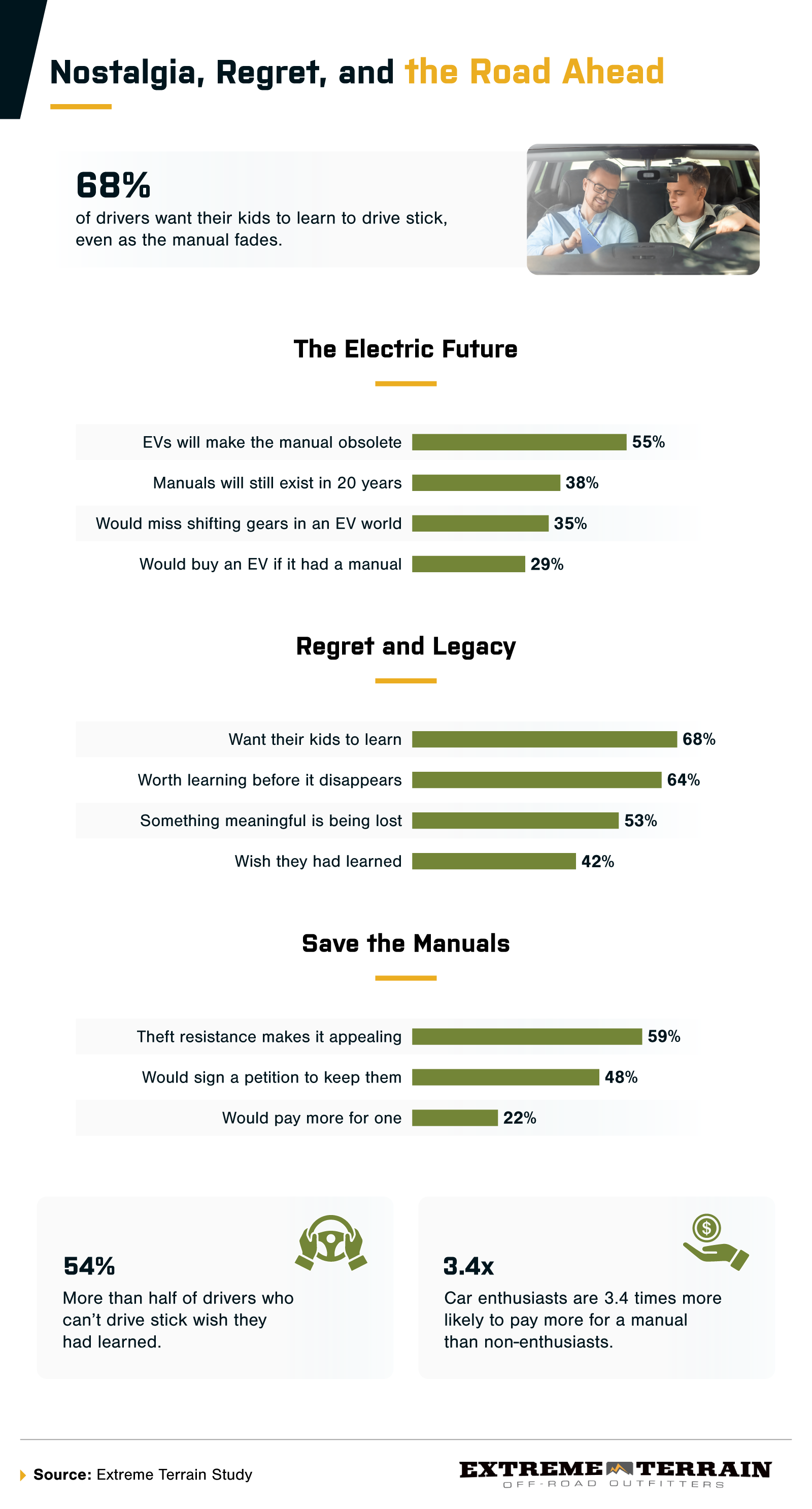
Plenty of drivers wish they'd learned. Among those who can't drive a manual, 54% said they wished they had, well above the 42% of all drivers who felt that way. The desire runs strongest among the young, with 56% of Gen Z wishing they'd learned or learned it better, more than double the 26% of baby boomers who said the same. Parents want to pass it on as well, as 68% hoped their children would learn to drive stick, including 40% of parents who can't do it themselves.
Americans sounded resigned to the manual's decline without fully accepting it. A majority (55%) believed EVs will eventually make the manual obsolete, and baby boomers were the most likely to call it a dying skill (95%, versus 78% of Gen Z). Only 38% thought manuals will still be around in 20 years. Still, 35% said they would miss shifting gears in an all-electric future, 53% felt something meaningful is being lost, and 29% would buy an EV specifically if it came with a manual.
The instinct to save the stick shift runs deep. Nearly half of drivers (48%) would sign a petition urging automakers to keep building manuals, a push that jumped to 69% among enthusiasts versus 39% of everyone else.
On top of that, 64% said learning is worth doing before the skill disappears, and 59% found manuals more appealing because they're harder to steal, a figure that rose to 73% among enthusiasts. Enthusiasts backed the nostalgia with their wallets, as 42% would pay more for or seek out a manual versus 12% of non-enthusiasts, and they were roughly 3.6 times as likely to own one today (25% versus 7%).
What a Fading Skill Says About American Car Culture
The manual transmission has become less a way to get around and more a symbol of skill, effort, and connection to the act of driving. Fewer young Americans are learning it, most people who can drive stick rarely do, and many expect electric cars to close the book on it. Yet the affection hasn't faded along with the skill, as drivers still admire the people who can do it, want their kids to learn, and hope automakers keep the option alive. If you've ever thought about learning, the data suggests you're far from alone, and the window to pick it up may be narrower than you think.
Methodology
Extreme Terrain surveyed 1,006 U.S. drivers about their experience with, attitudes toward, and predictions for manual transmission vehicles. Respondents were recruited, and the survey was fielded through CloudResearch Connect in July 2026.
Responses were cleaned before analysis. Records without a unique participant ID were removed, which eliminated one duplicate and produced the final sample of 1,006. Age was collected as a numeric value and converted into generational cohorts for reporting: Gen Z (18 to 29), millennials (30 to 45), Gen X (46 to 61), and baby boomers and older (62 and up).
Percentages are rounded to the nearest whole number and may not always sum to 100. Questions that allowed more than one answer are reported as a share of all respondents, so those totals can exceed 100%. Demographic breakdowns are shown only for groups representing at least 5% of the sample. Follow-up questions asked only of drivers who can operate a manual (how they learned, why, how often they drive one, and their confidence) are based on that subgroup of 758 respondents rather than the full sample.
As with any self-reported survey, findings reflect what respondents told us and may be subject to memory and social-desirability effects.
About Extreme Terrain
Extreme Terrain is a premier retailer specializing in Jeep parts and accessories for trail-ready builds. From daily drivers to weekend rigs, Extreme Terrain offers wheels and tires for 4x4 vehicles built to handle rough terrain, mud, rocks, and everything in between.
Fair Use Statement
You're welcome to share the findings and visuals from this study for any noncommercial purpose. We just ask that you link back to this page so readers can see the full research and Extreme Terrain receives proper credit.