

The Jeep Wrangler's towing capability often surprises those who view it purely as an off-road icon, but properly equipped Wranglers handle 3,500-5,000 pound trailers with confidence. Converting that capability into practical towing function requires appropriate hitches, accessories, and understanding of the Wrangler's unique considerations. Unlike traditional trucks with substantial rear overhang, the Wrangler's short rear departure creates specific challenges for hitch mounting and trailer clearance. The removable spare tire and bumper configurations demand careful hitch selection ensuring compatibility with various factory and aftermarket configurations. Our Wrangler towing collection addresses these specific requirements with receiver hitches engineered for Jeep mounting points, ball mounts and accessories designed for Wrangler geometry, trailer wiring harnesses integrating with Jeep electrical systems, and solutions for owners who need towing capability without sacrificing off-road clearance or spare tire access. Whether pulling camping trailers to remote destinations, hauling utility trailers for work, or towing toy haulers carrying dirt bikes and ATVs, proper equipment transforms your Wrangler into a genuinely versatile towing platform.
Our Jeep hitches & towing for Wrangler selection organizes options across critical decision categories:
Hitch Accessories Type- Ball Mount - Expertly engineered to deliver exceptional performance and lasting value, our ball mount options represent thoroughly vetted solutions meeting the exacting standards of enthusiasts who demand both quality and capability in every component.
- Flag Holder - Expertly engineered to deliver exceptional performance and lasting value, our flag holder options represent thoroughly vetted solutions meeting the exacting standards of enthusiasts who demand both quality and capability in every component.
- Wiring and Wiring Harnesses - Proper electrical integration ensures trailer lights, brakes, and charging systems function reliably and legally. Wrangler-specific harness designs plug directly into factory connectors, eliminating cutting or splicing while providing proper current capacity for trailer lighting. T-connector designs for simple installations or integrated modules for sophisticated trailer brake controller communication both preserve your Wrangler's electrical integrity.
- Trailer Accessories - Expertly engineered to deliver exceptional performance and lasting value, our trailer accessories options represent thoroughly vetted solutions meeting the exacting standards of enthusiasts who demand both quality and capability in every component.
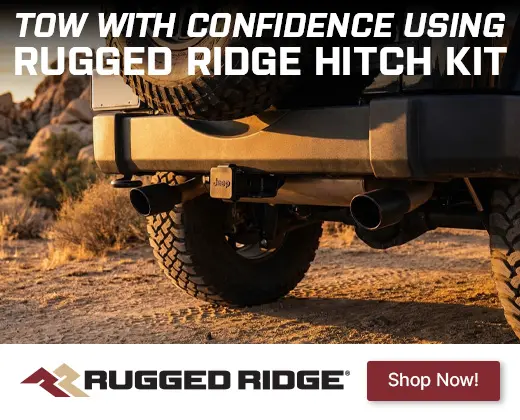
- Receiver Hitch - Standard 2-inch receiver hitches provide the versatility Wrangler owners demand—towing trailers, mounting bike racks, supporting cargo carriers, or adding steps. Class III-rated designs handle the Wrangler's full towing capacity while using bolt-on installation that preserves frame integrity. Quality receivers include powder-coated finishes resisting rust and corrosion through years of weather exposure and trail abuse.
- Front Mount Hitch - Expertly engineered to deliver exceptional performance and lasting value, our front mount hitch options represent thoroughly vetted solutions meeting the exacting standards of enthusiasts who demand both quality and capability in every component.
Successful Wrangler towing requires understanding weight ratings, hitch compatibility with bumpers and spare tire mounts, departure angle preservation, and electrical system integration. The Wrangler's unique platform creates specific considerations that don't apply to traditional trucks—short wheelbase affecting sway tendency, limited rear overhang restricting hitch length, and removable tops/doors requiring weatherproof wiring solutions. Making informed equipment selections ensures safe, capable towing while maintaining the off-road prowess that defines Wrangler ownership. Below we address critical questions that guide Jeep owners toward appropriate towing equipment and successful implementation.
Frequently Asked Questions
1. What is the Wrangler's actual towing capacity and what determines it?
Wrangler towing capacity varies significantly by model year, engine, drivetrain, and equipment. Two-door JK Wranglers (2007-2018) rate for 2,000 pounds, four-door JKU models handle 3,500 pounds, and JL Wranglers (2018+) tow 3,500-5,000 pounds depending on configuration. The 2.0L turbo four-cylinder in JL models rates for 3,500 pounds, while the 3.6L V6 handles up to 3,500-4,500 pounds depending on transmission and axle ratio. Diesel JL Wranglers achieve the highest capacity at 5,000 pounds when properly equipped. These ratings assume properly functioning brakes, appropriate trailer brakes, correct hitch class, and tongue weight within specifications (typically 10-15% of trailer weight). Exceeding towing capacity causes premature transmission wear, reduced braking effectiveness, accelerated suspension component failure, and dangerous handling characteristics. Before towing, verify your specific Wrangler's rating in the owner's manual—don't rely on generic information. If your towing needs exceed your Wrangler's capacity, no amount of upgrade equipment safely increases that limit. The ratings account for frame strength, transmission cooling capacity, brake system capability, and suspension design—all factors that cannot be upgraded to exceed manufacturer specifications. Our comprehensive guide Jeep Wrangler Towing and Hitches: A Guide covers everything you need to know about Wrangler towing.
2. How does the Wrangler's short wheelbase affect towing compared to traditional trucks?
The Wrangler's short wheelbase creates specific towing dynamics requiring awareness and sometimes additional equipment for safe operation. Short wheelbase vehicles are inherently more susceptible to trailer sway—the trailer's weight behind the rear axle creates larger leverage effect that can initiate swaying oscillations. This becomes particularly problematic with longer trailers where the trailer's length significantly exceeds the Wrangler's wheelbase, or with trailers having their weight concentrated toward the rear. Proper loading becomes absolutely critical—ensure 60% of trailer weight sits forward of the axle centerline, maintaining proper tongue weight of 10-15%. Weight distribution hitches become even more valuable on Wranglers than traditional trucks, transferring some tongue weight back to trailer axles while maintaining proper vehicle stance. Sway control systems, either integrated with weight distribution hitches or as standalone friction/electronic systems, dramatically improve stability. Many experienced Wrangler towers also use trailer brakes for any trailer over 2,000 pounds, as the independent braking helps prevent trailer push during descents or emergency stops. Drive more conservatively when towing with a Wrangler—allow extra following distance, reduce highway speeds 5-10 mph, and avoid sudden steering inputs that could initiate sway. With proper equipment and careful driving, Wranglers tow safely despite their short wheelbase, but they demand more attention than long-wheelbase trucks.
3. What hitch class do I need for my Wrangler's towing requirements?
Hitch class selection depends on your Wrangler's towing capacity and your actual towing needs. Class II hitches rate for 3,500 pounds towing and 300-350 pounds tongue weight—adequate for two-door Wranglers and many JKU applications. These hitches handle small utility trailers, lightweight tent trailers, or jet ski trailers comfortably. Class III hitches provide 5,000 pounds towing capacity and 500 pounds tongue weight—appropriate for four-door Wranglers at their maximum ratings and essential if approaching 3,500+ pound trailer weights. Even if your current trailer is light, Class III hitches provide upgrade flexibility and typically cost only marginally more than Class II units. Class III is the generally recommended choice for most Wrangler owners planning any serious towing. Some Wranglers can accept Class IV hitches rated for 10,000+ pounds, though this capacity far exceeds the Wrangler's towing capability—the heavy-duty hitch simply provides extra strength margin and durability for owners who regularly tow at the Wrangler's limits. Never use a hitch rated below your maximum intended towing weight, as exceeding hitch ratings creates catastrophic failure risk. Verify your chosen hitch specifically confirms compatibility with your Wrangler's generation, body style, bumper configuration, and spare tire mounting—assumptions about universal fit often prove incorrect, particularly with aftermarket bumpers. Our comprehensive guide Jeep Wrangler Towing and Hitches: A Guide covers everything you need to know about Wrangler towing.
4. Can I tow with aftermarket Wrangler bumpers and spare tire carriers?
Towing compatibility with aftermarket bumpers and tire carriers depends entirely on specific product designs and installation approach. Many aftermarket rear bumpers include integrated hitch receivers designed into their structure, providing proper load distribution through the bumper's mounting points. These integrated solutions often work better than add-on hitches because they're engineered as complete systems. However, some aggressive bumpers with reduced departure angles or unique mounting cannot accommodate hitches at all. Swing-away spare tire carriers create particular challenges—the carrier's weight and leverage stress hitch receivers, and opening the carrier while a hitch is installed may be impossible depending on designs. Some tire carriers incorporate separate hitch receivers that work with the carrier closed, while others require removing the hitch ball/mount before opening the carrier. Hidden hitch systems that tuck receivers behind bumpers or under the vehicle provide solutions for owners wanting clean aesthetics until actually towing. Before purchasing aftermarket rear bumpers, verify towing compatibility if you plan any trailer use. Many manufacturers offer bumper versions with integrated hitches or provisions for hitch installation. If you already have an aftermarket bumper, consult the manufacturer about hitch options—many offer retrofit kits or recommend compatible hitch products. Never improvise hitch mounting that bypasses proper frame attachment points, as this creates extremely dangerous failure scenarios.
5. What trailer wiring solution works best for Wranglers?
Wrangler trailer wiring requires solutions addressing the unique challenges of removable tops, doorless operation, and exposure to weather. The most reliable approach uses a Wrangler-specific T-connector harness that plugs directly into factory tail light wiring without cutting or splicing. These harnesses route through the body to a weatherproof 4-pin or 7-pin connector mounted to the hitch or frame rail. The sealed connector placement protects against water intrusion from rain, river crossings, or pressure washing. For Wranglers frequently running topless or doorless, ensure all wiring connections use weatherproof connectors and secure routing preventing damage from flopping in wind. Some enthusiasts prefer running trailer wiring through the frame rails or body channels for complete protection, though this complicates installation. If your trailer has electric brakes, you'll need a brake controller with Wrangler-specific mounting (dashboard or under-hood depending on year and preference). Modern electronic brake controllers integrate with the Wrangler's ABS system through data connections, providing smoother brake modulation than older proportional controllers. Regardless of wiring approach, use dielectric grease on all connections preventing corrosion, secure all wiring away from heat sources and moving suspension components, and periodically inspect for damage or wear. Many Wrangler owners also add quick-disconnect extensions allowing easy hitch removal when not towing, preventing theft and maintaining clean appearance.
Fitment Includes:
- 1976, 1977, 1978, 1979, 1980, 1981, 1982, 1983, 1984, 1985, 1986, 1987, 1988, 1989, 1990, 1991, 1992, 1993, 1994, 1995, 1997, 1998, 1999, 2000, 2001, 2002, 2003, 2004, 2005, 2006, 2007, 2008, 2009, 2010, 2011, 2012, 2013, 2014, 2015, 2016, 2017, 2018, 2019, 2020, 2021, 2022, 2023 and 2024 Jeep Wranglers
- Rubicon, Sahara, Sport S, Sport, Unlimited, Islander, Rocky Mountain, Renegade Wranglers
*Please see product pages for any exceptions.