Car ownership has always come with costs, but many drivers today are feeling a new level of financial strain. Rising car prices, long-term loans, and higher interest rates have pushed vehicle budgets to the breaking point — especially for middle-class Americans.
To understand how deep the burden goes, we surveyed more than 1,000 car owners and asked how ownership costs are affecting their spending habits, financial stability, and vehicle decisions. The results capture a growing reality: Keeping a car on the road is becoming harder for drivers across the country.
Key Takeaways
- Nearly 1 in 6 car owners spends more than 20% of their monthly income on their vehicle, exceeding recommended financial-planning guidelines.
- While 69% of car owners expect to be making payments for at least two more years, 23% could only keep up with payments for a month or less if they lost their job.
- More than half of car owners (54%) say they're keeping their current vehicle longer than they'd like because they can't afford to replace it.
- The average car on the road is now 8 years old, and 1 in 5 car owners say they've felt embarrassed by the age or condition of their vehicle.
- Nearly 1 in 4 drivers (23%) say they've taken on a side hustle specifically to cover the cost of owning their vehicle.
How Car Expenses Stack Up Against Income
Drivers across income levels are feeling the weight of rising car costs, and many are stretching their budgets too far. For some, the pressure is so high that one unexpected setback could put their vehicle and financial stability at risk.
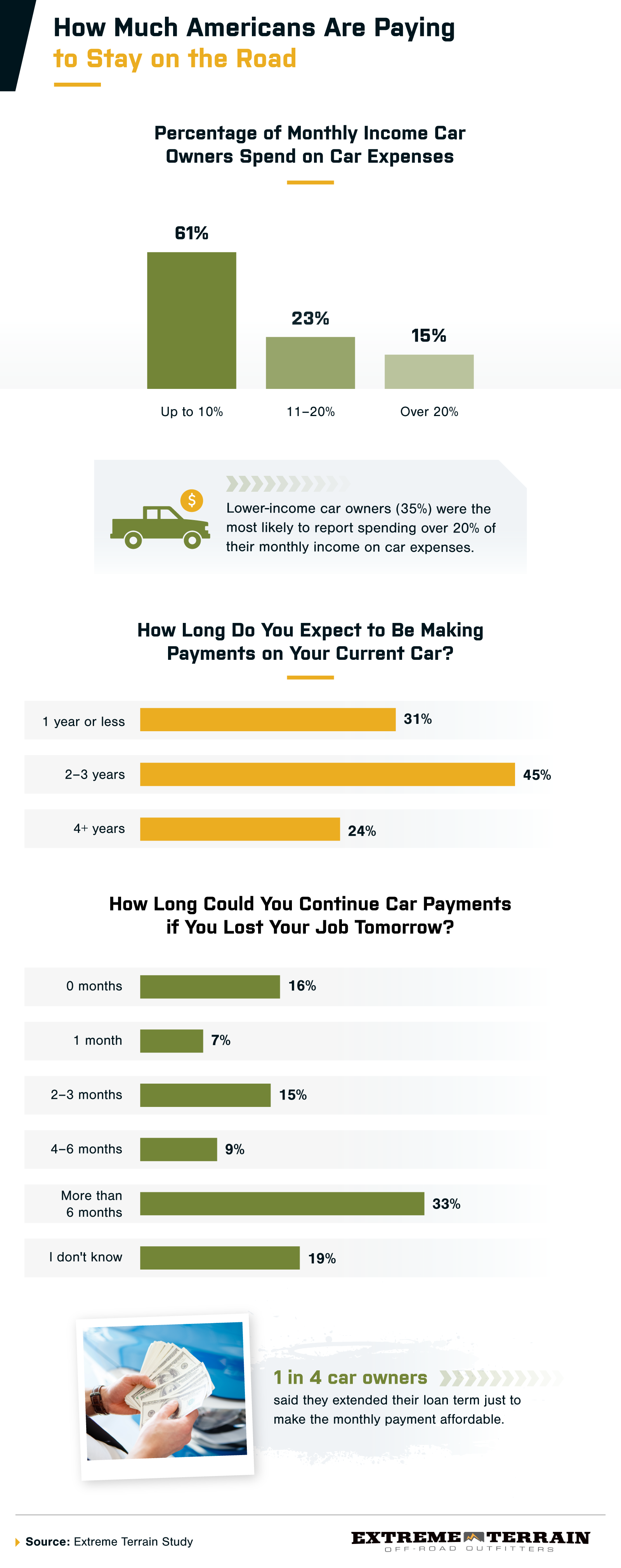
Among all car owners surveyed, 1 in 10 spends at least $1,000 per month on vehicle expenses. Nearly 1 in 6 owners now puts more than 20% of their monthly income toward their car, which is double the recommended 10% budgeting guideline. Chevrolet and Mercedes-Benz owners were the most likely to exceed this limit at 25% each, followed by GMC (22%), BMW (20%), and Toyota (19%).
Some drivers are also in difficult loan situations. Nearly 1 in 10 car owners said they were upside-down on their loan, meaning they owe more than the car is worth. Another 6% were not sure whether they had any equity in their vehicle. Although 69% expected to continue making payments for at least two more years, 23% said they could only afford their payments for a month or less if they lost their job.
Long-term loan expectations varied a lot by brand, adding another layer to the financial strain many drivers are experiencing. Volkswagen owners were the most likely to expect at least four more years of payments, at 43%, followed by Jeep (40%), Subaru (29%), Ford (28%), and owners of Kia and Hyundai (both at 27%). Tesla owners also stood out, with 1 in 5 expecting to continue making payments for at least four more years.
The Aging Car Fleet on U.S. Roads
As car prices continue climbing, many drivers are holding onto older vehicles much longer than they'd prefer. The divide between income groups and brands reveals how affordability gaps shape the age of America's cars.
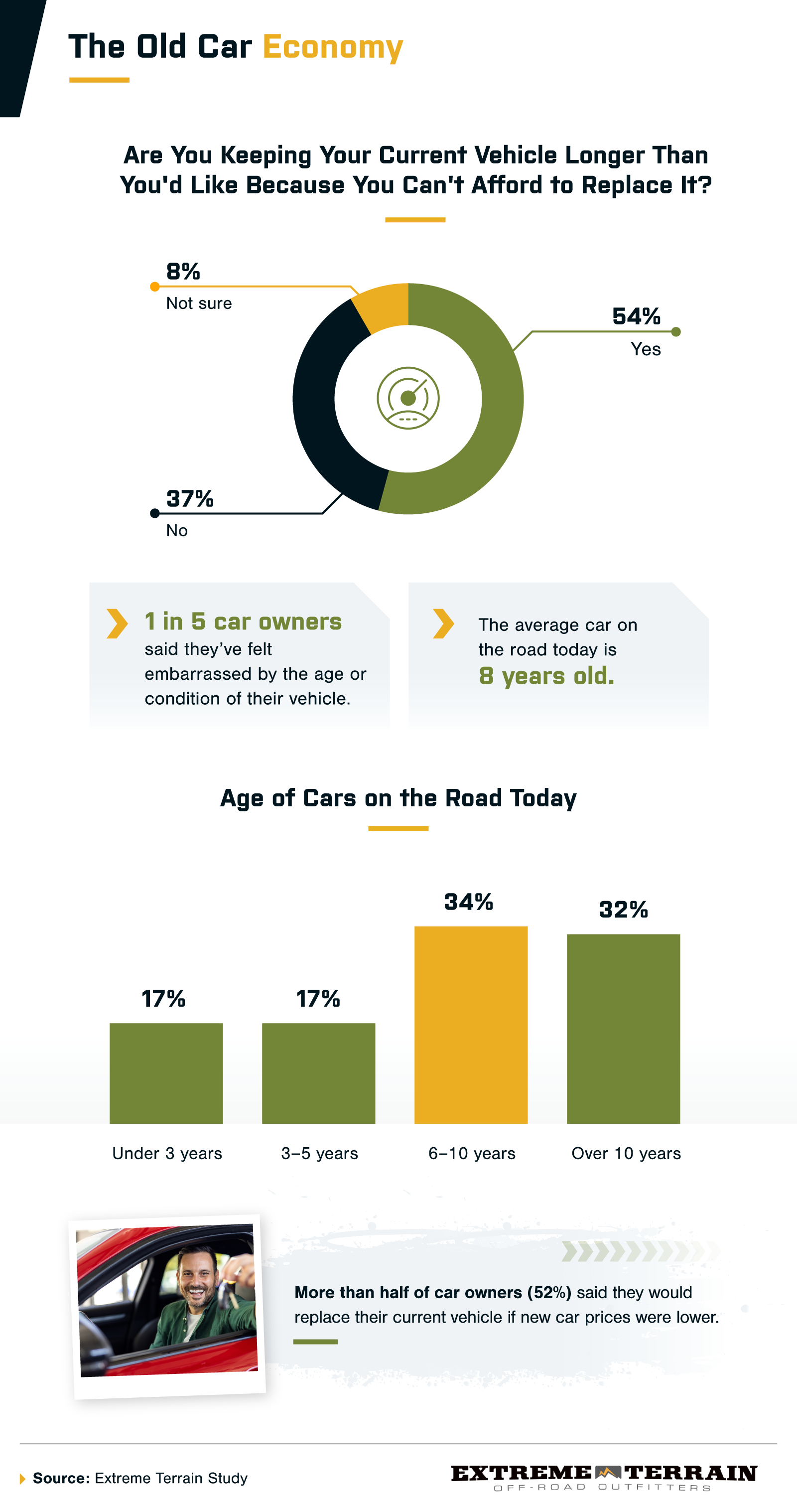
More than half of car owners (54%) said they were keeping their current vehicle longer than they'd like because replacing it wasn't financially realistic. The trend shows up clearly on the road, with the average U.S. car now being 8 years old. One in 5 owners said they've felt embarrassed by their vehicle's age or condition.
Income level played a major role. Nearly half of lower-income drivers (49%) were driving cars over 10 years old, while only 13% of upper-income drivers were in the same situation. In contrast, over 1 in 4 upper-income drivers (27%) owned cars under 3 years old, compared to just 9% of lower-income drivers.
Several brands skewed older than others. Ford led with 46% of its vehicles on the road more than 10 years old, followed by Dodge (44%), Lexus (43%), Honda (38%), and Jeep (36%). The newest cars on the road were most often Mazda vehicles (36%), followed by Hyundai (33%), Tesla (31%), and Mercedes-Benz and Subaru (both at 25%).
The Hidden Sacrifices of Car Ownership
Behind every monthly car payment is the trade-offs drivers make to stay mobile. For a growing number, the personal and financial sacrifices extend far beyond the bill itself.
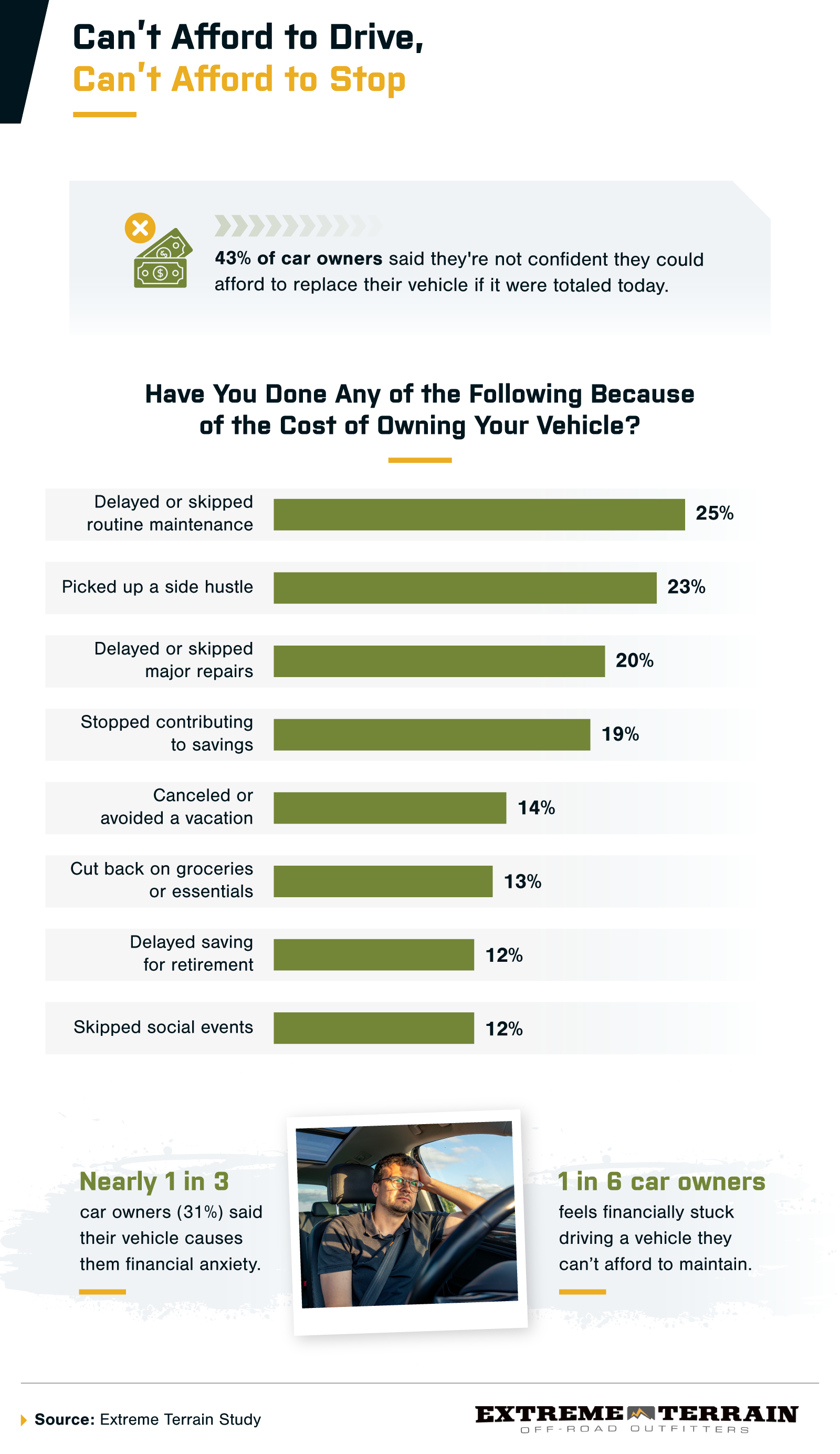
Some car owners are rethinking vehicle ownership altogether. Out of those surveyed, 1 in 10 have considered selling their car and relying on transit or ridesharing instead. Another 11% regretted buying their vehicle because the ongoing costs became too much to manage. To help with expenses, many drivers delayed or skipped maintenance (25%) and repairs (20%). Nearly 1 in 4 (23%) said they'd taken on a side hustle specifically to afford their vehicle.
Owning a car can cause significant financial stress, and the level of stress varies across different brands. The highest levels of stress were reported by Mercedes-Benz drivers (50%), followed by Dodge (47%), GMC (42%), Chevrolet (38%), and Volkswagen (35%) owners. About 1 in 3 Tesla owners (31%) said their car causes them financial anxiety.
The State of Car Debt in America
Car ownership has become a significant financial burden for millions of Americans. Drivers are extending loan terms, holding onto aging vehicles, and even taking on extra work just to stay behind the wheel. These insights show how dramatically the cost of mobility has shifted and how much pressure it places on everyday budgets. As the gap widens between what cars cost and what drivers can comfortably afford, it raises an important question: how sustainable is the future of car ownership?
Methodology
We surveyed 1,003 U.S. car owners to understand how rising vehicle costs are affecting financial stability, purchasing behavior, and long-term car ownership decisions. Income groups were defined using U.S. Census Bureau median household income benchmarks and Pew Research Center's methodology for identifying lower-, middle-, and upper-income tiers. Data was collected in December 2025.
About Extreme Terrain
Extreme Terrain is a premier retailer specializing in Jeep parts and accessories. Our experienced team of Jeep enthusiasts is dedicated to providing you with expert service and advice.
Fair Use Statement
Information from this article may be shared for noncommercial purposes only. If you do use or reference this content, please include a link back to ExtremeTerrain for proper attribution.