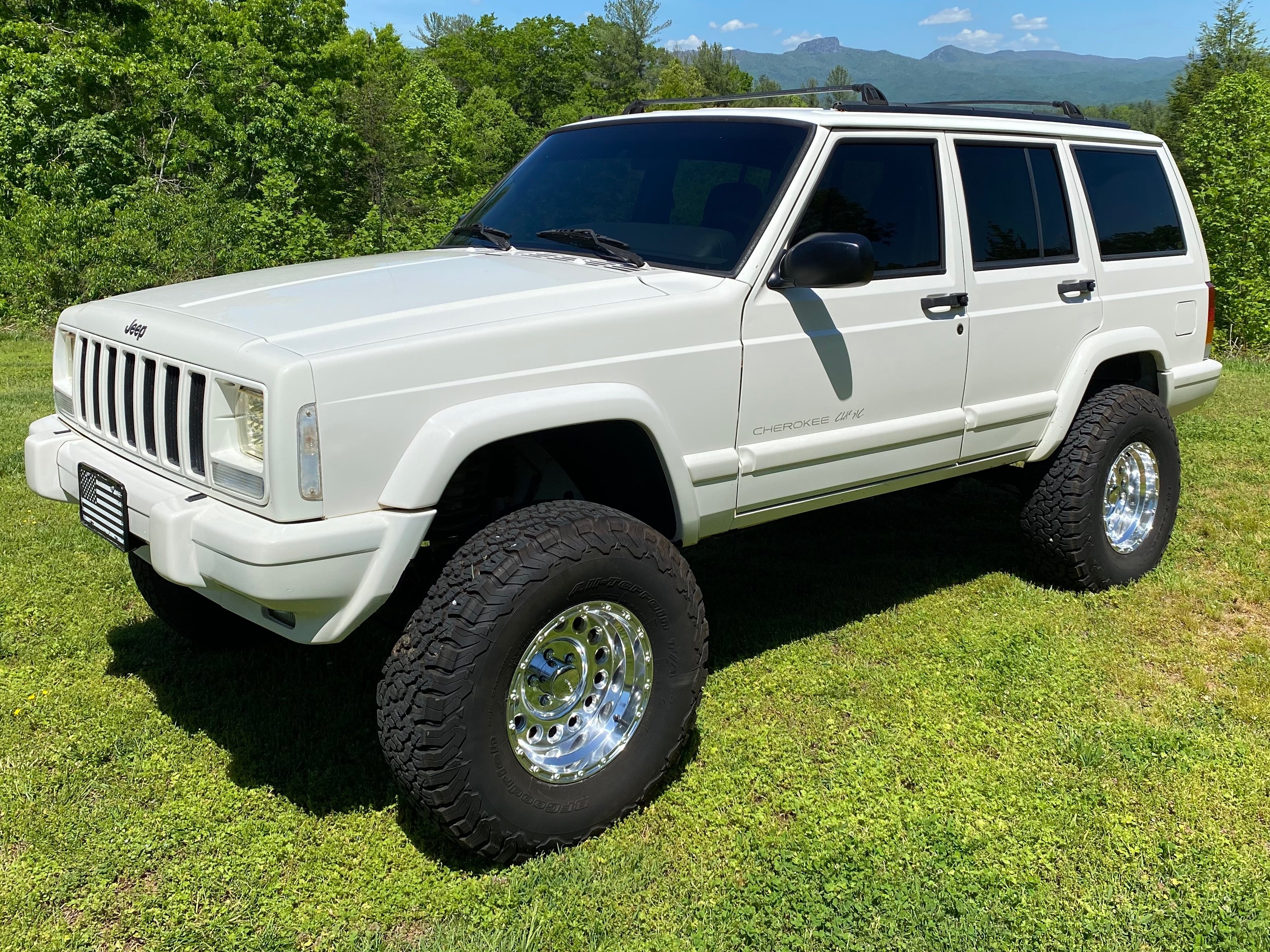
Shopping for new wheels for your Jeep Cherokee XJ? The first number you need is the bolt pattern — and for every XJ built between 1984 and 2001, that number is 5x4.5 inches (5x114.3mm). But bolt pattern is just the starting point. This guide covers everything you need to lock down fitment: year-by-year specs, which other Jeep models share the same pattern, wheel sizing and offset by lift height, how to measure your bolt pattern, and when wheel adapters or spacers make sense for your build. Whether you are planning your first wheel upgrade or dialing in a trail-ready setup, you will find the specs and answers here.
What Is the Jeep Cherokee XJ Bolt Pattern?
The Jeep Cherokee XJ bolt pattern is 5x4.5 inches (5x114.3mm) for all model years 1984 through 2001. That means five lug studs arranged in a circle with a 4.5-inch diameter. This pattern held consistent across every XJ trim level and engine option Jeep ever offered, so whether you have a base two-door with the 2.5L four-cylinder or a fully loaded four-door with the legendary 4.0L inline-six, your bolt pattern is the same.
A bolt pattern, sometimes called a lug pattern, defines the number of lug studs on the hub and the diameter of the imaginary circle they form. Getting this right is non-negotiable when you are shopping for wheels. Mount a wheel with the wrong bolt pattern and you are looking at studs that will not seat, uneven lug engagement, and a wheel that is not safe to drive on, let alone take down a trail.
Here are the core specs you need for the Cherokee XJ:
- Bolt Pattern: 5x4.5 inches (5x114.3mm)
- Number of Lugs: 5
- Bolt Circle Diameter: 4.5 inches (114.3mm)
- Center Bore: 71.5mm
- Lug Thread Size: 1/2"-20
These numbers are your starting point for every wheel decision on the XJ. With the bolt pattern and center bore locked in, your next questions are about wheel diameter, width, and offset, which determine what fits your specific build. For a deeper look at specs across the entire Jeep lineup, check out our Jeep wheel specifications guide.
Jeep Cherokee XJ Bolt Pattern Specs by Year
Every Cherokee XJ from 1984 to 2001 shares the same 5x4.5-inch bolt pattern regardless of trim level or engine option. Unlike some vehicles that changed bolt patterns mid-generation, Jeep kept the XJ consistent across its entire 17-year production run. That consistency is one of the reasons the XJ aftermarket is so strong: a wheel that fits a 1987 XJ fits a 2001 XJ, period.
|
Year Range
|
Bolt Pattern
|
Center Bore
|
Lug Thread
|
Torque Spec
|
|
1984–1990
|
5x4.5" (5x114.3mm)
|
71.5mm
|
1/2"-20
|
75–110 ft-lbs
|
|
1991–1996
|
5x4.5" (5x114.3mm)
|
71.5mm
|
1/2"-20
|
75–110 ft-lbs
|
|
1997–2001
|
5x4.5" (5x114.3mm)
|
71.5mm
|
1/2"-20
|
75–110 ft-lbs
|
The torque range of 75 to 110 ft-lbs depends on whether you are running steel or alloy wheels. Steel wheels generally sit at the lower end (75–85 ft-lbs) while alloy wheels call for the higher range (85–110 ft-lbs). Always check the wheel manufacturer's torque recommendation for your specific setup.
Which Jeep Models Share the XJ's 5x4.5 Bolt Pattern?
One of the best things about the XJ's 5x4.5 bolt pattern is how many other Jeep models share it. If you have a buddy with a Wrangler TJ in the garage or spot a set of Grand Cherokee ZJ wheels at a swap meet, there is a good chance they will bolt right up to your XJ. But "same bolt pattern" does not always mean "direct fit." You need to account for center bore differences and potentially run hub-centric rings to eliminate vibration.
|
Model
|
Years
|
Bolt Pattern
|
Center Bore
|
Compatible with XJ?
|
|
Wrangler YJ
|
1987–1995
|
5x4.5" (5x114.3mm)
|
71.5mm
|
Yes
|
|
Wrangler TJ
|
1997–2006
|
5x4.5" (5x114.3mm)
|
71.5mm
|
Yes
|
|
Grand Cherokee ZJ
|
1993–1998
|
5x4.5" (5x114.3mm)
|
71.5mm
|
Yes
|
|
Grand Cherokee WJ
|
1999–2004
|
5x4.5" (5x114.3mm)
|
71.5mm
|
Yes
|
|
Wrangler JK
|
2007–2018
|
5x5" (5x127mm)
|
71.5mm
|
No (requires adapter)
|
|
Wrangler JL
|
2018+
|
5x5" (5x127mm)
|
71.5mm
|
No (requires adapter)
|
The YJ, TJ, ZJ, and WJ all share the 5x4.5 pattern with the same 71.5mm center bore, making wheel swaps between these models about as straightforward as it gets. Just confirm the wheel width and offset work with your XJ's fender clearance and suspension geometry before bolting them on.
The JK and JL Wranglers moved to a 5x5 (5x127mm) bolt pattern starting in 2007. If you want to run those wider, more modern JK or JL wheel designs on your XJ, you will need a 5x5 to 5x4.5 wheel adapter. We cover that in detail in the adapters section below.
Even when the bolt pattern matches, aftermarket wheels from different applications may have a larger center bore than the XJ's 71.5mm hub. In that case, hub-centric rings fill the gap between the wheel's center bore and your hub, eliminating vibration and ensuring the wheel is properly centered. They are inexpensive, easy to install, and worth every penny if your wheels are not hub-centric to the XJ out of the box.
For more on how bolt patterns compare across the Jeep family, take a look at our guides on Wrangler and Gladiator bolt patterns and the complete bolt pattern guide for Jeep lovers.
Wheel Size, Offset, and Backspacing for the Cherokee XJ
Once you have the bolt pattern sorted, what is the next thing to figure out? Wheel diameter, width, offset, and backspacing. These four specs determine whether a wheel actually clears your brakes, sits flush with the fender, and leaves enough room for the tire size you want to run.
The factory Cherokee XJ came with 15x7-inch wheels and an offset in the +10 to +25mm range. That works perfectly for stock height with stock-size tires, but the moment you start lifting your rig and stepping up to bigger rubber, you need wider wheels with more aggressive offsets to get the stance and clearance right.
What Is Backspacing?
Backspacing is the distance from the wheel's mounting surface to its inner edge, measured in inches. A wheel with less backspacing pushes the tire outward from the hub, giving you a wider stance and more fender clearance on the inside. Backspacing and offset describe the same thing from different reference points: offset measures from the center of the wheel to the mounting surface (in millimeters), while backspacing measures from the back lip to the mounting surface (in inches). Lower offset equals less backspacing.
Wheel Fitment by Suspension Setup
|
Suspension Setup
|
Recommended Wheel Size
|
Offset Range
|
Max Tire Size
|
|
Stock
|
15x7 to 15x8
|
0 to +25mm
|
225/75R15 (29")
|
|
2" Leveling Kit
|
15x8
|
-6 to +20mm
|
30x9.5R15
|
|
3" Lift
|
15x8 to 16x8
|
-12 to +15mm
|
31x10.5R15
|
|
4.5" Lift
|
15x8 to 17x9
|
-12 to +6mm
|
33x12.5R15
|
A few things to keep in mind as you plan your wheel and tire combo:
- Wider wheels need more negative offset. As you go from a 7-inch to a 9-inch wide wheel, you typically need to drop the offset to keep the tire from rubbing the inner fender or suspension components.
- Fender trimming may be required. Even with the right offset, 31-inch and larger tires on a 3-inch lift can rub at full steering lock. A little trimming at the front fender corners solves it.
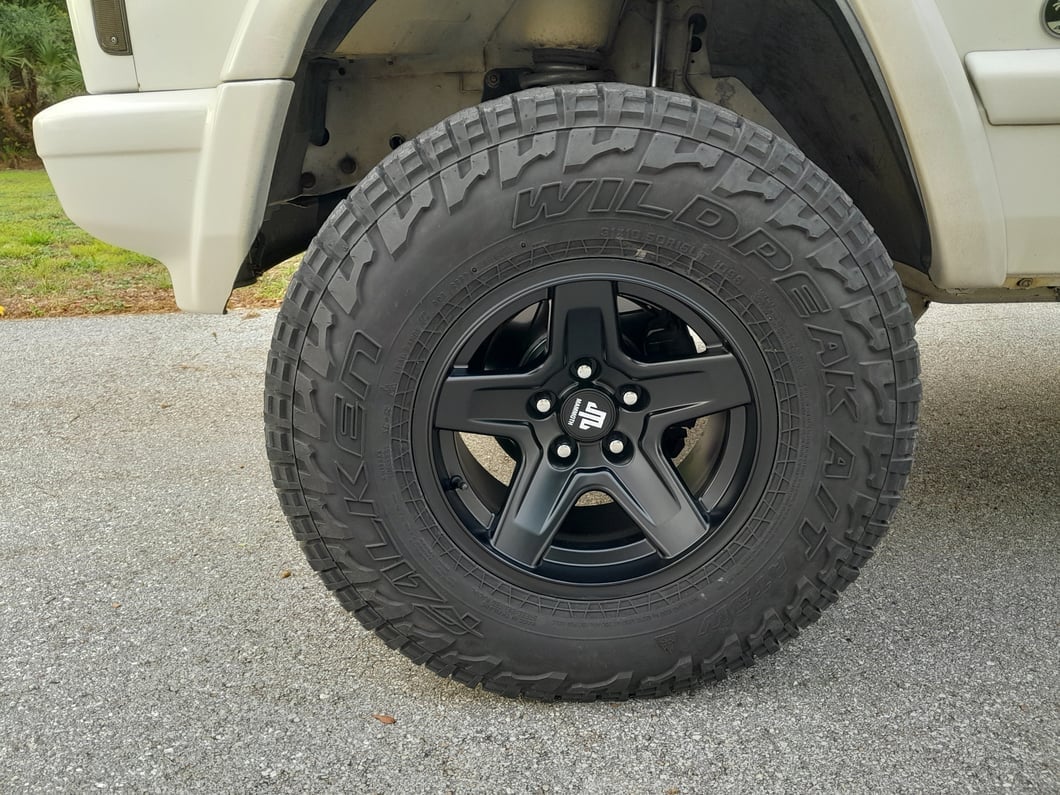
- 15-inch wheels are the sweet spot for most XJ builds. They clear the brakes, offer the widest aftermarket tire selection, and keep costs reasonable. Going to 16 or 17 inches is possible but limits your tire options and adds rotating weight.
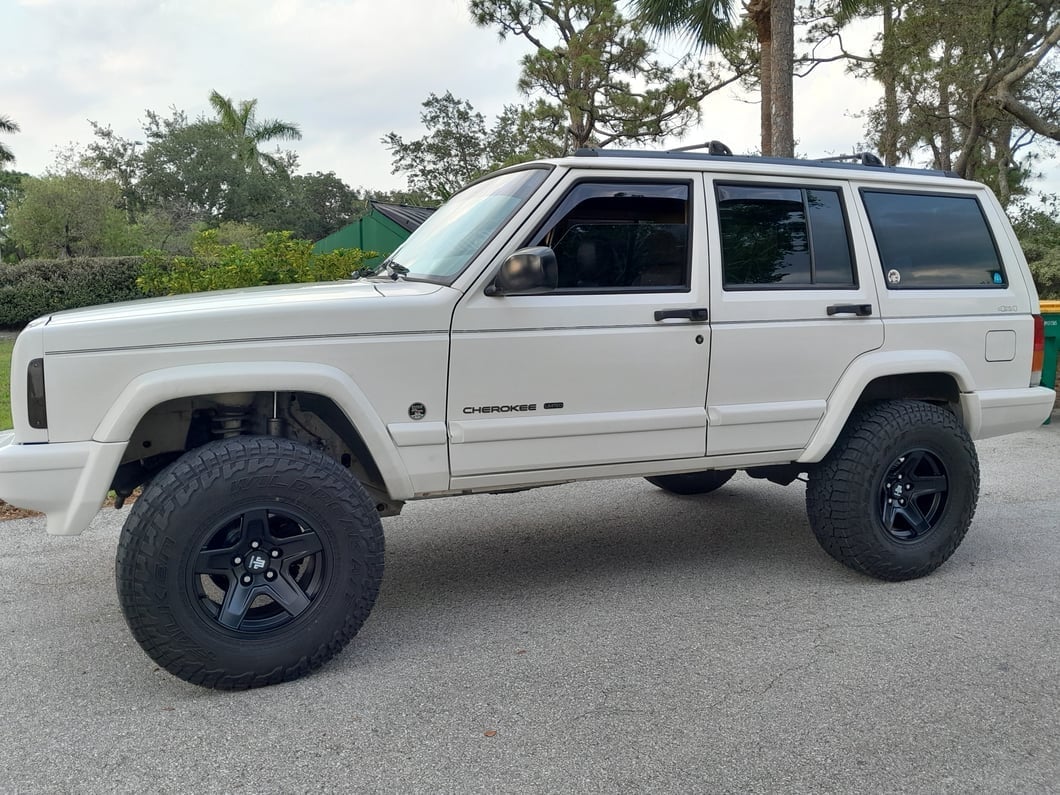
Ready to start shopping? Browse our full selection of Cherokee XJ wheels or check out pre-matched Cherokee XJ wheel and tire packages that come with free mount and balance — a confirmed-fit setup ready to bolt on. If you are planning a lift to go with your new wheels, take a look at our 3-inch lift kits for the Cherokee XJ. Not sure which wheel and tire combo works with your specific lift and fender setup? Our Sales Techs are real Jeep enthusiasts who build and drive these rigs — they can help you dial in the right fitment.
How to Measure a Bolt Pattern on Your Jeep Cherokee XJ
Do you know for certain your XJ is completely bone stock? If so, the answer is simple: 5x4.5 inches. But there are situations where measuring the bolt pattern yourself is the smart move. Previous owners may have swapped axles, installed different hubs, or done other modifications that changed the bolt pattern. A quick measurement takes five minutes and removes any doubt.
How to Measure a 5-Lug Bolt Pattern
Measuring an even-numbered bolt pattern (4-lug, 6-lug) is simple because you can measure straight across from one stud to the opposite stud. A 5-lug pattern is slightly different because no two studs sit directly opposite each other. Here is how to do it accurately:
- Pick any lug stud as your starting point. You can measure with the wheel on or off, but removing the wheel gives you easier access.
- Measure from the center of your starting stud to the far edge of the stud two positions away (skip one stud). On a 5-lug pattern, this means measuring from stud 1 to the far edge of stud 3.
- Read the measurement. For the XJ, you should get approximately 4.5 inches (114.3mm). If you are measuring to the far edge of the opposite stud as described, this method accounts for the offset geometry of the 5-lug layout.
- Confirm with a second measurement. Repeat from a different starting stud. Both measurements should match within 1-2mm.
If you want to be precise, a bolt pattern gauge tool makes this even easier. They are inexpensive, fit in your glovebox, and give you an instant read on both the bolt count and circle diameter.
Common Measurement Mistakes
- Measuring center-to-center on a 5-lug pattern. This gives you a smaller, incorrect number. Use center-of-one to far-edge-of-the-stud-two-away for accuracy.
- Confusing 5x4.5 with 5x4.75. These are close but not interchangeable. The 5x4.75 (5x120.7mm) pattern is a GM spec. If your measurement lands between the two, measure again more carefully.
- Assuming the pattern has not changed. XJs with Dana 44 rear axle swaps from a Ford or with aftermarket full-width axle conversions may have a different bolt pattern. If the rig has been modified, always measure.
Wheel Adapters and Spacers for the Cherokee XJ
Wheel adapters and spacers expand your options, but they are not all built the same. Are you trying to run JK or JL Wrangler wheels on your XJ? Or do you just need a wider stance for trail stability? Understanding when you need an adapter versus a spacer — and what to look for — keeps your rig safe and your wheels properly fitted.
When Do You Need a Wheel Adapter?
You need an adapter when the wheel you want to run has a different bolt pattern than your XJ's 5x4.5. The most common scenario is running JK or JL Wrangler wheels, which use a 5x5 (5x127mm) pattern. A 5x4.5 to 5x5 adapter bolts to your XJ hub and presents a new 5x5 stud pattern for the JK/JL wheel to mount to.
When Do You Need a Wheel Spacer?
Spacers push the wheel outward from the hub without changing the bolt pattern. You might use them to:
- Gain clearance between the tire and inner fender or suspension components
- Widen your stance for better stability on the trail
- Correct rubbing issues after a lift and larger tire upgrade
Common spacer sizes for the XJ are 1 inch, 1.25 inches, and 1.5 inches. Anything over 1.5 inches is generally better handled by choosing a wheel with the correct offset in the first place.
Hub-Centric vs. Lug-Centric: Always Go Hub-Centric
Hub-centric adapters and spacers have a machined center bore that fits snugly over your hub, centering the wheel precisely. Lug-centric spacers rely on the lug studs alone to center the wheel, which can lead to vibration, uneven lug stress, and potential stud failure under off-road loads. For any Jeep that sees trail use, hub-centric is the only way to go.
Safety Considerations
- Material matters. Look for 6061-T6 billet aluminum adapters. Cast adapters are weaker and more prone to cracking.
- Stud grade matters. Quality adapters use Grade 10.9 or higher studs.
- Torque and re-torque. Torque the adapter to your hub per the manufacturer's spec, then torque the wheel to the adapter. Re-torque both after 50 to 100 miles.
- Thickness impacts geometry. Every inch of adapter or spacer changes your scrub radius and puts additional stress on wheel bearings and ball joints. Run the thinnest adapter that gets the job done.
If you are planning a more involved build that includes both a lift and a wheel change, check out our full selection of Cherokee XJ lift kits to make sure your suspension and wheel choices work together. Have questions about which adapter thickness or spacer size makes sense for your specific build? Our Sales Techs can walk you through the options — real advice from real enthusiasts who wrench on these rigs.
Bolt Grades and Lug Nut Specs for the Cherokee XJ
Your wheels are only as secure as the lug nuts holding them on. Using the right grade and torquing them correctly is especially important on a rig that sees off-road use, where impacts, vibration, and lateral loads can work hardware loose faster than on pavement.
Lug Nut Thread Size
The Cherokee XJ uses 1/2"-20 lug studs across all model years. When you are buying lug nuts, match this thread pitch exactly. A 1/2"-20 nut on a different thread pitch stud will cross-thread and fail.
Bolt Grades
Lug nuts come in different strength grades. For the XJ, stick with Grade 8 or higher:
- Grade 8 (SAE): 150,000 psi tensile strength. The standard for aftermarket wheel hardware on off-road rigs.
- Grade 10.9 (Metric): Approximately equivalent to SAE Grade 8. Common on quality wheel adapters and spacers.
- Grade 12.9 (Metric): Higher strength, used in some heavy-duty and racing applications. Overkill for most XJ builds but not a problem if your adapter or wheel came with them.
Torque Specifications
Wheel Material Recommended Torque Steel Wheels 75–85 ft-lbs Alloy Wheels 85–110 ft-lbs
Torquing Best Practices
- Use a star pattern. Tighten lug nuts in a star (criss-cross) sequence rather than going around the circle. This seats the wheel evenly against the hub.
- Use a torque wrench. Do not guess. An impact gun gets them tight, but a calibrated torque wrench gets them right.
- Re-torque after 50 to 100 miles. New wheel installs, spacers, and adapters all need a re-torque check after a short break-in period. This is especially critical after off-road use where vibration and impacts can loosen hardware.
- Skip the anti-seize on lug studs. Anti-seize changes the torque relationship between your wrench setting and the actual clamping force. Torque specs assume clean, dry threads.
Getting your lug hardware right is a small detail with big consequences. Use the right grade, torque to spec, and re-check after your first drive. That is the difference between a wheel that stays where it belongs and one that does not.
Key Takeaways
![]() The Jeep Cherokee XJ bolt pattern is 5x4.5 inches (5x114.3mm) with a 71.5mm center bore and 1/2"-20 lug studs — identical across every model year from 1984 to 2001.
The Jeep Cherokee XJ bolt pattern is 5x4.5 inches (5x114.3mm) with a 71.5mm center bore and 1/2"-20 lug studs — identical across every model year from 1984 to 2001.- The Wrangler YJ, TJ, Grand Cherokee ZJ, and Grand Cherokee WJ share the same 5x4.5 bolt pattern, making cross-fitment straightforward with hub-centric rings where needed.
- Stock XJs run 15x7 wheels with +10 to +25mm offset. Lifted rigs can accommodate 15–17-inch wheels with more negative offsets, depending on lift height.
- Always use hub-centric adapters (never lug-centric) if you need to convert from 5x4.5 to 5x5 for JK/JL wheels.
- Torque your lug nuts to 75–110 ft-lbs (depending on wheel material) using a star pattern, and re-torque after 50–100 miles.
Get Your Cherokee XJ Wheel Upgrade Started
The Cherokee XJ's 5x4.5 bolt pattern opens up a massive range of wheel options, from direct-fit aftermarket wheels to cross-compatible hardware from other Jeep platforms. Whether you are building a stock-height daily driver or a lifted trail machine, getting the bolt pattern, offset, and lug specs right means you can focus on where you are going instead of worrying about what is holding your wheels on.
Browse our full catalog of Cherokee XJ wheels and tires to find the right setup for your build. And if you are upgrading more than just wheels, explore our selection of Cherokee XJ exterior accessories to round out your project. Not sure which setup is right for your specific lift and build? Our Sales Techs are real Jeep enthusiasts who can help you dial in the perfect wheel, tire, and suspension combo — real advice from people who actually wrench on these rigs.
Frequently Asked Questions About Jeep Cherokee XJ Wheel Bolt Patterns
Below are the most common questions Jeep Cherokee XJ owners ask about bolt patterns, wheel fitment, and upgrading their wheels.
What Is the Bolt Pattern on a Jeep Cherokee XJ?
Every Jeep Cherokee XJ from 1984 to 2001 uses a 5x4.5-inch bolt pattern, also expressed as 5x114.3mm. This means the wheel has five lug nuts arranged in a circle with a 4.5-inch (114.3mm) diameter. The pattern remained consistent across all XJ trim levels and engine options throughout the entire production run.
Do All Jeep Cherokee XJ Model Years Have the Same Bolt Pattern?
Yes. Jeep kept the 5x4.5-inch (5x114.3mm) bolt pattern unchanged for every Cherokee XJ produced between 1984 and 2001. Whether you own an early 2.5L four-cylinder model or a late 4.0L inline-six, the bolt pattern is identical, so wheels interchange freely across all XJ model years.
What Other Jeep Models Share the 5x4.5 Bolt Pattern With the XJ?
The Jeep Wrangler TJ (1997–2006), Wrangler YJ (1987–1995), Grand Cherokee ZJ (1993–1998), and Grand Cherokee WJ (1999–2004) all share the 5x4.5-inch bolt pattern with the Cherokee XJ. This cross-fitment makes it easy to swap wheels between these models without adapters.
How Do You Measure a 5-Lug Bolt Pattern?
To measure a five-lug bolt pattern, measure from the back edge of one lug hole to the center of the lug hole directly across from it. On the Cherokee XJ, this measurement should read 4.5 inches or 114.3mm. Avoid measuring center-to-center on five-lug patterns, as that method only works accurately on even-numbered patterns.
What Size Wheels Fit a Jeep Cherokee XJ?
Stock Cherokee XJs came with 15-inch wheels, but aftermarket wheels ranging from 15 to 17 inches in diameter and 7 to 10 inches in width fit properly. The recommended wheel offset range is -6mm to +32mm. Larger diameters up to 17 inches work well with lift kits, while 15-inch wheels offer the widest tire selection for off-road use.
What Is the Recommended Lug Nut Torque for a Jeep Cherokee XJ?
Jeep specifies a lug nut torque of 75 to 110 ft-lbs for the Cherokee XJ, depending on the wheel type. Steel wheels typically require 75–85 ft-lbs, while alloy wheels call for 85–110 ft-lbs. Always torque lug nuts in a star pattern and re-torque after the first 50–100 miles of driving on newly installed wheels.
Can You Use Wheel Adapters or Spacers on a Jeep Cherokee XJ?
Yes, wheel adapters and spacers work on Cherokee XJs and are commonly used to fit wheels from vehicles with different bolt patterns or to widen the stance. Hub-centric adapters that convert from 5x4.5 to 5x5 (5x127mm) allow you to run Wrangler JK wheels on your XJ. Always use hub-centric, not lug-centric, adapters for safe highway driving.
What Wheel Offset Works Best for a Jeep Cherokee XJ?
The factory Cherokee XJ wheel offset is approximately +10mm to +25mm. For a stock-height XJ, stay within -6mm to +32mm to avoid rubbing. Lifted XJs can run lower offsets down to -12mm or wider for a more aggressive stance. Lower offset pushes the wheel outward, which improves stability off-road but may require fender trimming.